Document control
August 2025
Document Version 4.0
For Internal Use Only
Document Review and Approval
Revision History:
| Version | Author | GRC & Compliance Team | Revision Notes |
|---|---|---|---|
| 1.0 | 09-Nov-2026 | SecureXcel controlled baseline | GRC & Compliance Team |
Table of Contents
1. Overview
1.1 Introduction
SecureXcel Private Limited is a cybersecurity, governance, risk and compliance (GRC), and assurance services company. Its activities include cybersecurity assessments, offensive security testing, security and control reviews, GRC and compliance advisory, privacy and risk-management support, incident-response and forensic assistance, security utilities, and an enterprise GRC platform. The Enterprise Risk Management framework supports informed decision-making across strategic, operational, financial, technology, cybersecurity, legal, compliance, people, third-party and resilience risks relevant to these activities.
A key factor for a Company’s capacity to create sustainable value is the risks that the Company is willing to take and its ability to manage them effectively. The ability to identify and manage risks promptly is also a critical aspect of corporate governance at any Company. Many risks exist in a Company’s operating environment and continuously emerge on a day-to-day basis. Risk Management does not aim at eliminating them, as that would simultaneously eliminate all chances of rewards/ opportunities. Risk Management is instead focused on ensuring that these risks are known and addressed through a pragmatic and effective Risk Management process.
This Risk Management Policy and Procedure aim to provide specific procedures to operationalize the Risk Management Charter of the Company.
1.2 Objectives
The objectives of Risk Management at SecureXcel are:
- To establish a risk intelligence framework for the Company.
- To establish ownership throughout the Company and embed Risk Management as an integral part of the business rather than a stand-alone system.
- To help the decision makers of the SecureXcel explicitly take account of uncertainty, the nature of that uncertainty, and work towards a solution to address it.
- To ensure that all the current and expected risk exposures of the SecureXcel are identified, qualitatively and quantitatively evaluated, analyzed, and appropriately managed.
- To enable compliance with the relevant legal and regulatory requirements and international norms.
- To assure demonstrable achievement of objectives and improvement of the financial stability of the SecureXcel.
- To develop a risk-intelligent culture that supports strategic decision-making and improves business performance.
Risk Management is an integral part of business practices at SecureXcel. This Risk Management Policy and Procedure aim at formalizing a process to deal with the most relevant risks at SecureXcel, building on existing management practices, knowledge, and structures.
1.3 Legal Regulation
The Securities and Exchange Board of India (SEBI) has included Risk Management as part of Securities & Exchange Board of India. (Listing Obligations and Disclosure Requirements) Regulations 2015 (LODR) requirement as amended time to time. As per Regulation 17 of the SEBI LODR, disclosures to the Board are to be made by the listed entity on whether the risk assessment and its minimization procedures are in place. As per the Companies Act 2013, there are specific requirements for Risk Management that a Company needs to comply with. In addition, the Board of Directors and Risk Committee have been vested with specific responsibilities in assessing the robustness of risk management policy, process, and systems.
1.4 Risk Definitions
- Risk: Any event/non-event, the occurrence/non-occurrence of which can adversely affect the objectives of the Company. These threats may be internal/ external to the Company, may/may not be directly influenced by the Company and may arise out of routine/non-routine actions of the Company.
- Risk Management: A structured, consistent, and continuous process across the entire Company for identifying, assessing, deciding on responses to and reporting on the opportunities and threats that may affect the achievement of its objectives.
1.5 Effective Date
This Policy and Procedure are applicable w.e.f. December 1,2022.
1.6 Scope and Process Overview
The contents of this document apply to the Risk Management Department or Finance Department of SecureXcel. Any exception to the policies stated herein shall be subject to the approval of the Risk Management Committee or their assignees under the Delegation of Authority (DoA) matrix.
This Policy and Procedure set out guidelines to be followed by the Risk Management Department within SecureXcel.
This document describes policies, processes, and procedures for the Enterprise Risk Management (ERM) process applicable within SecureXcel.
1.7 Custody of Document
The custodian of this Policy and Procedure document is the designated team by Management. All enquiries and matters relating to this Policy and Procedure: content, implementation, scope, objectives, etc., should be addressed to the designated team by Management.
The Policy and Procedure custodian is responsible for safeguarding and updating the Policy and Procedure, its content and distribution whether in whole or part.
The content of the Policy and Procedure must be approved by the Management.
This document and its updates are effective from the date of approval unless otherwise specifically mentioned.
1.8 Confidentiality and Distribution Control
The Policy and Procedure are an internal document and may contain business/customer-sensitive information. Hence, it should be kept in a safe place and should be used with discretion for office work only. Unauthorized copying shall not be allowed and if discovered, will lead to disciplinary action.
Hard copies of the Policy and Procedure shall be distributed on a “need to know” basis with a soft copy in non-editable PDF format available.
To properly manage business-sensitive information and distribute amendments made to the Policy and Procedure from time to time, a list of custodians of the Policy and Procedure (known as the Distribution log) is provided above. The Distribution Log should be updated when copies are distributed to staff or changes in personnel take place in SecureXcel.
1.9 Maintenance of Document
- 1. The Policy and Procedure should be reviewed and approved on an annual basis to reflect changes in the business activities of SecureXcel. It should align with the business activities of SecureXcel.
- 2. The frequency and responsibilities of review and approval are illustrated in the following table:
| Review | Review Frequency | Responsibility for review | Approval |
|---|---|---|---|
| Policies | Annually or as required | Designated team by Management and Internal Risk Committee | Risk Management Committee (RMC) of the Board * or Competent Authority * |
| Procedures | Annually or as required | Designated team by Management | Internal Risk committee * or Competent Authority * |
* Approval is required only in the event of any modifications
- 3. Amendments to the Policy and Procedure are usually made because of one or a combination of the following reasons:
- Changes in the business strategies and policies of SecureXcel.
- Changes in functions and activities of SecureXcel.
- Changes in business processes.
- Changes in SecureXcel structure.
- Changes in regulatory norms or authority structure; and/or
- Changes in job roles, duties, and descriptions.
- Any factors or circumstances which lead to an amendment to the existing Policy and Procedure
- 4. Requests for updating the Policy and Procedure (add/delete/amend) can only be originated by a user of the Policy and Procedure. Such change requests should also highlight the impact of the changes being proposed.
- 5. This Policy and Procedure will be updated to ensure that all changes, whether temporary or permanent, are properly authorized and documented, and that its contents constantly reflect the current practices in ERM aspects.
- 6. Updates will be processed only through a Request for Amendment (RFA) Form as detailed in Annexure 9. The origin form remains with the custodian and a copy is given to the originator of the request.
- 7. Initial and final approval of any changes will be given following the maintenance and review frequency guidelines set out in this section.
- 8. Updates to Policy and Procedure should be followed as per the process below.
| Sr. No. | Procedures | Action Taken By |
|---|---|---|
| Start of Activity | ||
| Discuss with the Designated team by Management and if needed, the External Risk Management Consultant the need for amendments and agree/disagree on the course of action. | Designated team by Management or External Risk Management Consultant | |
| Fill out the RFA Form and forward it to the Designated team by Management or the External Risk Management Consultant for review. | Designated team by Management or External Risk Management Consultant | |
| Review and forward to the Designated team by Management or the External Risk Management Consultant for review and approval. | Designated team by Management or External Risk Management consultant | |
| Review and forward the form to the respective personnel as per the process defined in the below sections (defined as a part of the Risk Management structure – Section 2.2) to obtain their approvals. | Designated team by Management or External Risk Management Consultant | |
| Review, provide feedback, if any, and approve the requested changes. If the changes are related to Risk Policy and Procedure, RMC approval is needed. | Designated team by Management or External Risk Management Consultant | |
| Review and approve the requested risk practice changes and risk policies, if any. | RMC | |
| On receipt of the approved amendment form, request the respective Risk Management staff to make the required amendments. | Designated team by Management or External Risk Management Consultant | |
| Update the Policy and Procedure with the amendments and submit it to the Designated team by Management or the External Risk Management Consultant for review. | Designated team by Management or External Risk Management Consultant | |
| Review the updates and ensure they are aligned with the approved amendments. | Designated team by Management or External Risk Management Consultant | |
| Distribute the updated chapters to the concerned staff and upload the updated Policy and Procedure on the shared drive. | Designated team by Management or External Risk Management Consultant | |
| File supporting documents, outdated and new sections along with the updated Policy and Procedure. | Designated team by Management or External Risk Management Consultant |
1.10 Distribution of Updates
- 1. Each section of this Policy and Procedure is numbered. Circulation/distribution of the Policy and Procedure, its subsequent updates and temporary changes will be controlled and monitored.
- 2. Distribution of the Policy and Procedure, its updates, or temporary changes, in whole or part, will be made only to designated functions and officers as set and approved by the Policy and Procedure custodian.
- 3. It will be the responsibility of the custodian to ensure that the Policy and Procedure are properly updated in terms of adding new pages, removing superseded pages and/or making any editing changes.
1.11 Copyrights
- 1. This Policy and Procedure and its content are strictly for internal use and are as such treated as highly confidential material.
- 2. No part of this Policy and Procedure may be reproduced, stored in any system or form, or transmitted in any form by any means – electronic, mechanical, photocopied, recorded, or otherwise – without the prior written consent of the Policy and Procedure custodian.
- 3. Violation of the above clause subjects an individual or SecureXcel to applicable legal proceedings as per the laws of the State and SecureXcel’s internal policies.
- 4. No one other than SecureXcel’s employees can have access to this Policy and Procedure without the prior consent of the Policy and Procedure’s custodian.
1.12 Risk Management Structure
The Management of SecureXcel may appoint an External Risk Management Consultant for carrying out the activities for Risk Management.
1.13 Abbreviations
| Sr. No. | Abbreviation | Description |
|---|---|---|
| 1 | RFA | Request for Amendment |
| 2 | DoA | Delegation of Authority |
| 3 | BU | Business Unit |
| 4 | ERM | Enterprise Risk Management |
| 5 | RTM | Risks That Matter |
| 6 | MIS | Management Information System |
| 7 | RMC | Risk Management Committee |
| 8 | RPT | Related Party Transactions |
| 9 | BoD | Board of Directors |
| 10 | CFO | Chief Financial Officer |
| 11 | COO | Chief Operating Officer |
| 12 | CIO | Chief Information Officer |
| 13 | CEO | Chief Executive Officer |
| 14 | IT | Information Technology |
| 15 | CRM | Customer Relationship Management |
| 16 | PBT | Profit Before Tax |
| 17 | Engineering LeadI | Key Process Indicator |
| 18 | KRI | Key Risk Indicator |
2. Risk Management Policy and Procedure
While defining and developing a formalized Risk Management process, leading Risk Management standards and practices have been considered. However, at SecureXcel, the focus has been to make this process relevant to business reality and to keep it pragmatic and simple from an implementation and use perspective.
The SecureXcel Risk Management Framework outlines the series of activities and their enablers that SecureXcel proposes to deploy to assess, mitigate and monitor risks across the SecureXcel.
- SecureXcel is committed to developing an Integrated Risk Management Policy & Framework: To achieve strategic objectives while ensuring appropriate management of risks.
- To ensure the protection of stake holder’s value
- To provide a clear and strong basis for informed decision-making at all levels of the SecureXcel
- To strive towards strengthening the Risk Management system through continuous learning and improvement
- To create a ‘risk-aware’ culture across the SecureXcel
- To anticipate and take preventive action to manage risks.
All employees of SecureXcel must strive to take responsibility for effective Risk Management in all aspects of the business. Every employee of the Company is recognized as having a role in Risk Management, from the identification of risk to its treatment and shall be invited and encouraged to participate in the process.
The Designated team by Management or the External Risk Management Consultant shall determine key risks, communicate the policy, objectives, procedures, and guidelines, and direct and monitor the implementation, practice, and enable performance of Risk Management throughout SecureXcel.
The Board and Risk Management Committee nominated by the Board of Directors shall review the Risk Management Framework and Policy and recommend changes, if any, at least once every year.
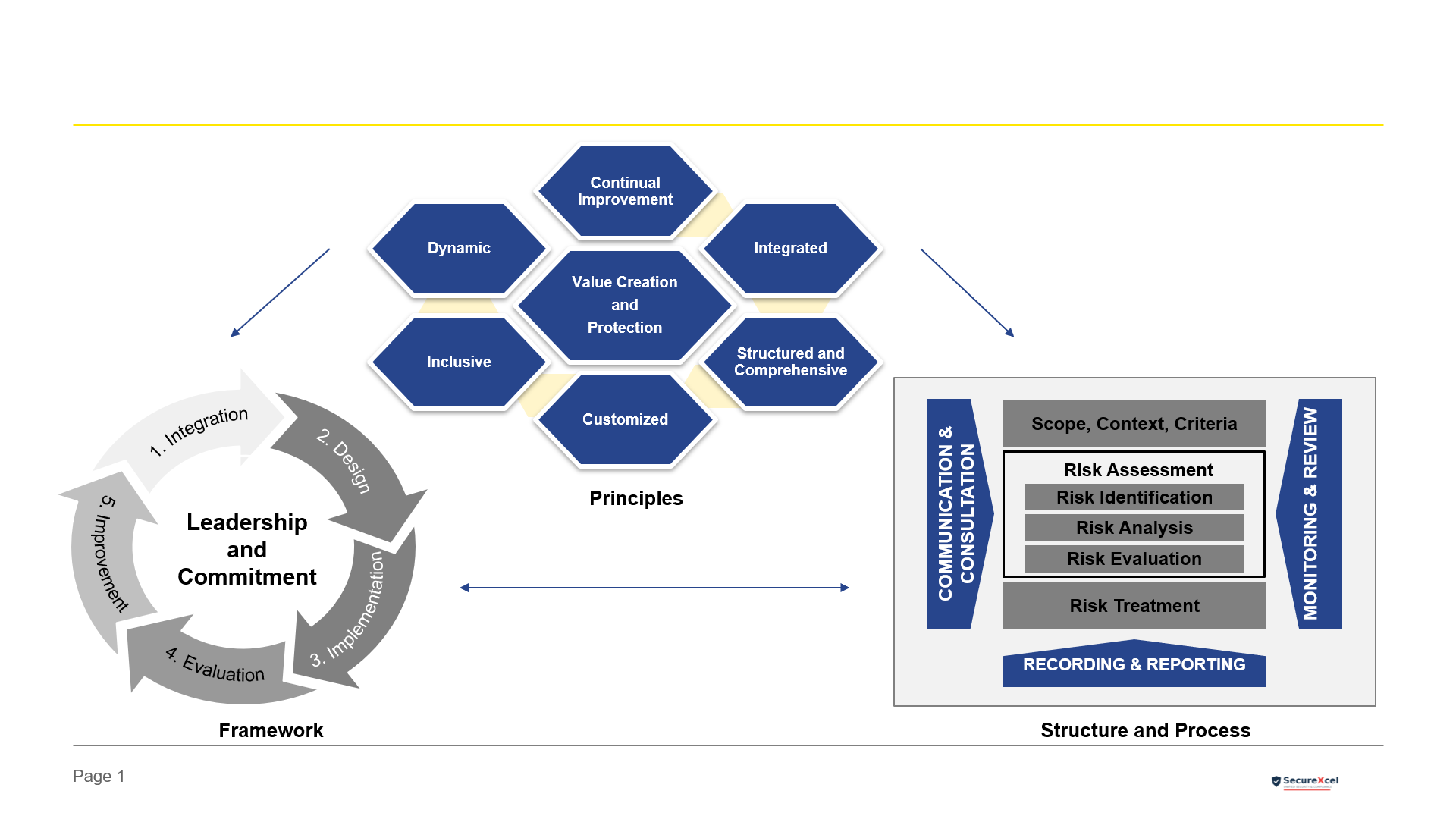
The Risk Management Governance at SecureXcel comprises essentially 4 elements:
- 1. Risk Management principles to provide guidance on the characteristics of effective and efficient risk management, communicating its value and explaining its intention and purpose. The principles are the foundation for managing risk and should be considered when establishing SecureXcel’s risk management framework and processes. These principles should enable SecureXcel to manage the effects of uncertainty on its objectives.
- 2. Risk management framework to assist the SecureXcel in integrating risk management into significant activities and functions. The effectiveness of risk management will depend on its integration into the governance of the SecureXcel, including decision-making. This requires support from stakeholders, particularly top management. Framework development encompasses integrating, designing, implementing, evaluating, and improving risk management across the SecureXcel.
- 3. Risk Management structure i.e., the enablers that are created to operationalize the process. These are in the form of roles & responsibilities, reporting calendars etc.
- 4. Risk Management process i.e., the process to identify, analyze, prioritize, reporting, monitor and manage risks in the Company.
Below is a diagrammatic representation of SecureXcel Risk Management.
2.1 Risk Management Principles
SecureXcel follows the following principle for effective and efficient risk management.
- 1. Risk management is integrated into the SecureXcel’s processes and functions.
- 2. Risk management is structured and comprehensive contributing to consistent and comparable results.
- 3. Risk management is customized and proportionate to the SecureXcel’s external and internal context related to its objectives.
- 4. Risk management is inclusive and transparent and includes timely involvement of stakeholders enables their knowledge, views, and perceptions to be considered.
- 5. Risk management is dynamic, fluid, and responsive to change as risks can emerge, change, or disappear as SecureXcel’s external and internal context changes. Risk management anticipates, detects, acknowledges, and responds to those changes and events in an appropriate and timely manner.
- 6. Risk management takes into consideration the best available information like historical and current information, as well as on future expectations, any limitations and uncertainties associated with such information and expectations. Information should be timely, clear, and available to relevant stakeholders.
- 7. Risk management considers human factors and the company culture which can significantly influence all aspects of risk management at each level and stage.
- 8. Risk management encourages and drives continual improvement through learning and experience.
2.2 Risk Management Framework
Framework development encompasses integrating, designing, implementing, evaluating, and improving risk management across the SecureXcel. Below illustrates the components of a framework.
| S.No. | Components of framework | Guiding principle |
|---|---|---|
| 1 | Leadership and commitment | Top management and oversight bodies should ensure that risk management is integrated into all SecureXcel activities and demonstrate leadership and commitment by: - Customizing and implementing all components of the framework. - Issuing a statement or policy establishing a risk management approach, plan, or course of action. - Allocating necessary resources to managing risk. - Assigning authority, responsibility, and accountability at appropriate levels within SecureXcel. This will help SecureXcel to: - Align risk management with its objectives, strategy, and culture. - Recognize and address all obligations and voluntary commitments. - Establish and communicate the amount and type of risk to guide the development of risk criteria. - Communicate the value of risk management to SecureXcel and its stakeholders. - Promote systematic monitoring of risks. - Ensure the risk management framework remains appropriate to SecureXcel's context. Top management is accountable for managing risk, while oversight bodies are responsible for overseeing risk management. Oversight bodies should: - Ensure risks are considered when setting SecureXcel’s objectives. - Understand the risks facing SecureXcel in pursuit of its objectives. - Ensure systems to manage risks are implemented and effective. - Ensure risks are appropriate in the context of SecureXcel’s objectives. - Ensure proper communication of information about risks and their management. |
| 2. | Integration | - Integrating risk management requires understanding SecureXcel structures and context, which vary based on purpose, goals, and complexity. - Risk is managed throughout the SecureXcel, and everyone has a responsibility for it. - Governance directs the SecureXcel's course, relationships, and necessary rules, processes, and practices. - Management structures convert governance direction into strategy and objectives for sustainable performance and long-term viability. - Assigning risk management accountability and oversight is essential to governance. - Integrating risk management is dynamic and iterative, tailored to the SecureXcel's needs and culture, and should be embedded in the SecureXcel purpose, governance, leadership, strategy, objectives, and operations. |
| 3. | Design | 3.1 Understanding the SecureXcel (as SecureXcel) and its context. When designing the risk management framework, the SecureXcel management should understand its external and internal context. Examining the external context includes: - Social, cultural, political, legal, regulatory, financial, technological, economic, and environmental factors (international, national, regional, or local) - Key drivers and trends affecting SecureXcel objectives. - External stakeholders’ relationships, perceptions, values, needs, and expectations - Contractual relationships and commitments - Complexity of networks and dependencies Examining the internal context includes: - Vision, mission, and values - Governance, SecureXcel structure, roles, and accountabilities - Strategy, objectives, and policies - SecureXcel culture - Standards, guidelines, and models adopted. - Capabilities in terms of resources and knowledge (capital, time, people, intellectual property, processes, systems, and technologies) - Data, information systems, and information flows Relationships with internal stakeholders, considering their perceptions and values. - Contractual relationships and commitments - Interdependencies and interconnections 3.2 Articulating risk management commitment Top management and oversight bodies should clearly demonstrate their continual commitment to risk management through policies, statements, or other forms. This commitment should be communicated within SecureXcel and to stakeholders, as appropriate, and should include: - The SecureXcel’s purpose for managing risk and its links to objectives and other policies. - The need to integrate risk management into the overall culture. - Leading the integration of risk management into core business activities and decision-making. - Authorities, responsibilities, and accountabilities. - Allocation of necessary resources. - Addressing conflicting objectives. - Measurement and reporting within performance indicators. - Ongoing review and improvement. 3.3 Assigning roles, authorities, responsibilities, and accountabilities. Top management and oversight bodies, where applicable, should ensure that the authorities, responsibilities, and accountabilities for relevant roles in risk management are assigned and communicated at all levels in SecureXcel. They can: 1. Emphasize that risk management is a core responsibility. 2. Identify individuals with the accountability and authority to manage risk (risk owners). 3.4 Allocating resources Top management and oversight bodies must allocate appropriate resources for risk management, including: - People, skills, experience, and competence. - SecureXcel processes, methods, and tools for managing risk. - Documented processes and procedures. - Information and knowledge management systems. - Professional development and training needs. - capabilities and constraints of existing resources. 3.5 Establishing communication and consultation. Top management and oversight bodies should establish an approved approach to communication and consultation to support the framework and facilitate effective risk management. Communication involves sharing information with targeted audiences, while consultation involves participants providing feedback to shape decisions or activities. Methods and content should reflect stakeholder expectations. Communication and consultation should be timely, ensuring relevant information is collected, collated, synthesized, and shared appropriately. Feedback should be provided, and improvements should be made. |
| 4. | Implementation | Top management and oversight bodies should implement the risk management framework in SecureXcel by: - Developing an appropriate plan, including time and resources. - Identifying where, when, and how different types of decisions are made across the SecureXcel, and by whom. - Modifying applicable decision-making processes where necessary. - Ensuring that the SecureXcel’s arrangements for managing risk are clearly understood and practiced. Successful implementation requires stakeholder engagement and awareness. This enables SecureXcel to address uncertainty in decision-making and account for new or subsequent uncertainty. A well-designed and implemented framework will integrate risk management into all activities, including decision-making, and capture changes in external and internal contexts. |
| 5. | Evaluation | To evaluate the effectiveness of the risk management framework, the Top management and oversight bodies should: - Periodically measure the performance of the risk management framework against its purpose, implementation plans, indicators, and expected behavior. - Determine if it remains suitable to support the SecureXcel's objectives. |
| 6. | Improvement | 6.1 Adapting The SecureXcel should continually monitor and adapt the risk management framework to address both external and internal changes, enhancing its overall value. 6.2 Continually Improving The SecureXcel should continuously improve the suitability, adequacy, and effectiveness of the risk management framework and its integration process. Upon identifying gaps or improvement opportunities, the SecureXcel should develop plans and tasks, assigning them to accountable individuals. Once implemented, these improvements should enhance risk management. |
2.3 Risk Management Process
Whether risks are external or internal to the Company, or can be directly influenced/ managed or not, these are all managed through a common set of processes at SecureXcel.
This process is scheduled as per Risk Management Activities Calendar along with the business planning exercise or at any point in time on account of significant changes in internal business conduct or external business environment. Where the business seeks to undertake a non-routine transaction (such as an acquisition, entering a new line of business etc.), the Risk Management process is activated as a part of the proposal for undertaking such a transaction. Management can appoint an External Consultant to carry out the activities of Risk Management. Diagrammatic representation of Integrated risk management framework is presented below.
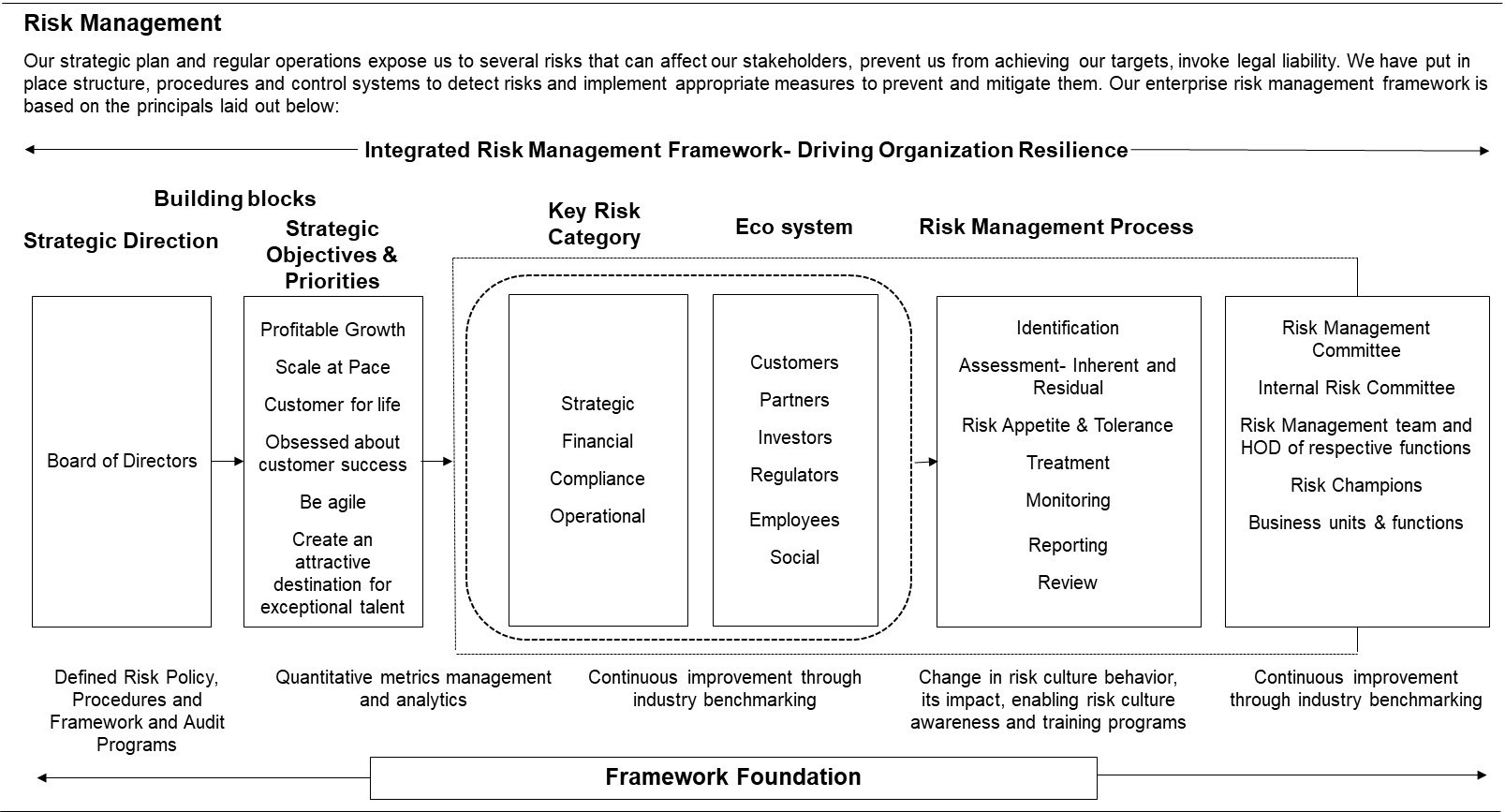
The overall Risk Management process covers:
- 1. Setting the context:
The risk management process involves the systematic application of policies, procedures, and practices to the activities of communicating and consulting, establishing the context and assessing, treating, monitoring, reviewing, recording, and reporting risk.
The risk management process should be integrated into the SecureXcel's management and decision-making, across its structure, operations, and processes. It can be applied at strategic, operational, program, or project levels, with customized applications to achieve objectives and fit the external and internal context. Throughout the process, the dynamic and variable nature of human behavior and culture should be considered. While often presented as sequential, the risk management process is, in practice, iterative.
Establishing the scope and context involves establishing the external, internal and Risk Management context in which the rest of the process will take place, the criteria against which risk will be evaluated and the structure of the analysis be defined.
Understanding the external and internal environment is the first step in the Risk Management process along with linking to SecureXcel strategies. It considers the challenges and opportunities in the context of SecureXcel’s strategies, vision and objectives, operating environment, and key stakeholders. The key objectives of this step include the following:
- To understand and consider SecureXcel’s strategic objectives, the environment in which it operates, the risk to achieving SecureXcel’s strategic objectives and the criteria by which the risks will be assessed.
- To establish the internal context
- To establish the external context
- To establish a Risk Management context
- To align core values, decision-making, and employees’ behavior to Risk Management cultures
The linkage of SecureXcel's strategy to Risk Management is vital for achieving long-term success. By incorporating risk considerations into strategic decision-making, SecureXcel can identify and address potential threats, seize opportunities, and position itself as an agile and resilient player in the marketplace.
A well-integrated approach to Risk Management of SecureXcel enables businesses to navigate uncertainties effectively, enhance stakeholder confidence, and unlock new avenues for growth and innovation. In the risk-aware culture at SecureXcel, all SecureXcel employees shall know what SecureXcel stands for, SecureXcel’s core values and the boundaries within which they can operate.
They can openly discuss and debate which risks should be taken to achieve SecureXcel’s strategy and business objectives, with the result being employee and management behavior that is more consistently aligned with SecureXcel’s risk appetite.
Below is an illustrative diagrammatic representation of linking strategy to Risk Management: -
Managing both types of risks are key to strategy realization and the long-term growth of SecureXcel.Managing both types of risks are key to strategy realization and the long-term growth of SecureXcel.
Risk from Strategy
Risk to Strategy
Risk to the execution of SecureXcel’s stated strategy.Undermine SecureXcel’s ability to achieve or maintain exceptional performance.Risk related to the entity’s processes and internal systems that supports strategic objectives. Process risk.Operational risksInvolved stakeholders- Head of Department, Process OwnersRisk to the execution of SecureXcel’s stated strategy.Undermine SecureXcel’s ability to achieve or maintain exceptional performance.Risk related to the entity’s processes and internal systems that supports strategic objectives. Process risk.Operational risksInvolved stakeholders- Head of Department, Process OwnersRisks that may impact the assumptions underlying to SecureXcel StrategyChallenge the logic of the Company’s strategic choices.Threaten SecureXcel’s competitive position.Identification and documentation of the risk affecting the strategy, and objectives of the business.Reviewing the strategy with risk lensInvolved stakeholders- CEO, CFO, CIO, and Senior ManagementRisks that may impact the assumptions underlying to SecureXcel StrategyChallenge the logic of the Company’s strategic choices.Threaten SecureXcel’s competitive position.Identification and documentation of the risk affecting the strategy, and objectives of the business.Reviewing the strategy with risk lensInvolved stakeholders- CEO, CFO, CIO, and Senior Management
Benefits of Linking Strategy to Risk for SecureXcel:
- Improved resilience: A well-integrated Risk Management approach strengthens SecureXcel's resilience to unforeseen events, allowing it to withstand and recover from disruptions more effectively.
- Enhanced competitive advantage: By proactively managing risks and capitalizing on opportunities, companies can gain a competitive edge in the marketplace. They can respond quickly to changing market conditions and exploit emerging trends, positioning themselves for sustainable growth.
- Stakeholder confidence: Effective Risk Management integrated into the strategic decision-making process enhances stakeholder confidence. Investors, customers, and regulators are more likely to trust and engage with companies that demonstrate a comprehensive understanding of risks and implement appropriate measures to mitigate them.
- Innovation and agility: Viewing risk as an opportunity encourages a culture of innovation and agility within SecureXcel. Companies that are open to embracing positive risks can experiment with new ideas, technologies, and markets, fostering growth and fostering a culture of continuous improvement.
At SecureXcel, the Company has embraced a risk-aware culture by:
- Maintaining strong leadership: SecureXcel’s Risk Management Committee and Management place importance on creating the right risk awareness and tone throughout SecureXcel. Culture and, therefore, risk awareness cannot be changed from the second-line team or department functions alone; SecureXcel management shall be the real driver of change.
- Employing a participative management style: SecureXcel Management shall encourage personnel to participate in decision-making and to discuss risks to strategy and business objectives.
- Enforcing accountabilities for all actions: SecureXcel Management shall document policies of accountability and adhere to them, demonstrating to personnel that lack of accountability is not encouraged; and that practicing accountability is appropriately rewarded.
- Aligning risk-aware behavior and decision-making with performance: Remuneration and incentive programs of SecureXcel shall be aligned to the core values of SecureXcel including expected behavior, adherence to codes of conduct, and promoting accountability for risk-aware decision-making and judgment.
- Embedding risk in decision-making: SecureXcel Management addresses risk consistently when making key business decisions, which includes discussing and reviewing risk scenarios that can help everyone understand the interrelationship and impacts of risks before finalizing decisions.
- Having open forum discussions about risks vulnerable to SecureXcel: SecureXcel Management does not view risk as being only negative and understands that managing risk is critical to achieving the strategy and business objectives.
- Encouraging risk awareness across SecureXcel: SecureXcel Management continually sends messages to personnel that managing risk is a part of their daily responsibilities, and that it is not only valued but also critical to SecureXcel’s success.
- 2. Identifying and Prioritizing Risks, which comprises:
Risk identification and definition – Focused on identifying relevant risks that can adversely affect the achievement of the objectives and consider identifying risks associated with upside events and opportunities. It seeks at creating/updating risk definitions to ensure an undisputed understanding of the potential threat.
Risk classification – Focused on understanding the various impacts of risks and the level of influence that the Company has on their root causes.
Risk prioritization – Focused on determining risk priority. This involves an assessment of the various impacts taking into consideration the risk appetite of the Company.
- 3. Managing risks, which comprise:
Risk mitigation – Focused on addressing critical risks to restrict their impact(s) to an acceptable level (i.e. – within the defined risk appetite). This involves performing a risk competence scan to identify ongoing mitigation actions and any improvements required. This involves the definition of ownership, responsibilities, and milestones for the risk response plan of the Company.
Risk reporting and monitoring – Focused on providing to the Board of Directors, the Risk Management Committee and Line Management periodic information on the risk profile and effectiveness of the implementation of the mitigation plans.
- 4. Communication and consultation:
The purpose of communication and consultation is to help stakeholders understand risk, decision-making bases, and the reasons for required actions. Communication aims to raise awareness and understanding, while consultation gathers feedback for decision-making. Coordination between the two ensures timely, relevant, and accurate information exchange, considering confidentiality, integrity, and privacy. It should occur throughout the risk management process, aiming to:
- Combine expertise at each step.
- Consider diverse views in defining and evaluating risks.
- Provide information for oversight and decision-making.
- Foster inclusiveness and ownership among affected parties.
2.2 Risk Management Structure
The Risk Management process at SecureXcel is supported by a set of enablers that make Risk Management an ongoing activity. These enablers take the form of:
- 1. Policies that define the Company’s risk appetite and underlying principles for managing risks & undertaking transactions
- 2. Risk Management Activity Calendar that summarizes the different activities to be performed by the Company for effective Risk Management
- 3. Roles and structure for Risk Management and oversight. At SecureXcel, the following set of roles & responsibilities have been prescribed:
- Governance The Board of Directors are responsible for defining and approving the Risk Management Framework. The Board of Directors have delegated direct oversight responsibility of Risk Management to the Risk Management Committee. The Risk Management Committee is thus responsible for monitoring the risks and Risk Management process by reviewing: (i) periodic risk reporting produced by the Executive Management; and (ii) reports from the various Assurance functions.
- ExecutionExecutive Management is responsible for operationalizing the Risk Management Framework at SecureXcel. This includes identifying & prioritizing risks, operationalizing mitigation strategies and reporting on risk mitigation. Management can take support from External Consultants to perform the ERM activities. Management can outsource the activities carried out for Risk Management to external consultants.
- For routine business activities: Business Unit (‘BU’) head/Function heads are required to implement the Risk Management Framework within their respective area. While they are responsible for performance on risks, they may designate specific risk owners to assist them in managing risks. Each business unit/function has a risk owner who oversees & coordinates the deployment of Risk Management activities within the BU/function.
- For non-routine business activities: Certain activities/decisions are non-routine and represent one-off transactions. These include activities such as mergers & acquisitions, divestments, entering new lines of business, ERP implementation, etc. The Executive-in-charge of such a transaction has the responsibility for operationalizing Risk Management for such activities.
- Monitoring
Designated team by Management or External Risk Management Consultant is entrusted with the responsibility to review and provide independent assurance on the overall effectiveness and efficiency of the Risk Management process. While all risks cannot be reviewed, the Designated team by Management, External Consultant, or any other function(s) entrusted by the Risk Management Committee may provide independent assurance on the effectiveness of defined risk mitigation strategies for certain areas.
As part of their annual audit planning exercise, these functions shall take specific inputs from the Risk Management Committee on the level and extent of assurance required on specific risks. In addition, these functions through their regular audit/ fieldwork at various levels might identify additional risks, which will serve as an input for the subsequent risk identification and definition process.
As SecureXcel requirements might change, the capabilities and value it seeks from Enterprise Risk Management may also change. Enterprise Risk Management shall be tailored to the capabilities of SecureXcel, considering both what SecureXcel is seeking to attain and the way it manages risk. It is natural for the operating structure to change as the nature of the business and its strategy evolves. Management, therefore, shall regularly evaluate the operating structure and associated reporting lines. Management can appoint an External Consultant to perform Risk Management activities like:
- Kick-off risk identification and assessment annual workshop
- Initial update of the Risk Register
- Quarterly update of the Risk Register
- Annual update of the Risk Register
- Quarterly testing
- Risk monitoring reports.
- Escalation of identified risks.
- Risk monitoring of non-routine business activities
- Risk reporting non-routine business activities.
- Exception to the procedure
- Exception to policy adherence
The Group CFO and Risk Management Committee of the Board shall review and approve such activities from time to time.
2.3 Limitation
SecureXcel Risk Management Framework does not intend to provide complete assurance against failures to achieve business objectives, nor does it provide full assurance against material misstatements, losses, frauds, human errors, misjudgments in decision-making and violations of legislation and regulation. The risk-related information outlined in risk management process may not cover all possible risks. The discussion may include forward-looking statements. The business is subject to uncertainties that could result in significant differences between actual results and those expressed in the forward-looking statements. If any of these risks materialize, they could have a material and adverse impact on business, financial condition, or prospects. Additionally, business, operating results, financial performance, or prospects could be negatively affected by risks and uncertainties currently unknown to SecureXcel or that SecureXcel did not consider material. Users of risk management outputs are advised to refer to the detailed discussion of risk factors and related disclosures in our regulatory filings and to exercise their judgment in assessing the risks associated with the Company.
3. Risk Management Procedures
SecureXcel operates through business functions, service teams and centralized support functions. Risks are identified and managed through decisions and operations within these functions and through enterprise-level governance. Risk Management is therefore operationalized at the functional and enterprise levels, with significant strategic or cross-functional risks escalated to the designated management and risk governance body. The Enterprise Risk Management framework is aligned with ISO 31000 and relevant leading practices and supports a consistent approach to risk identification, assessment, treatment, monitoring and reporting.
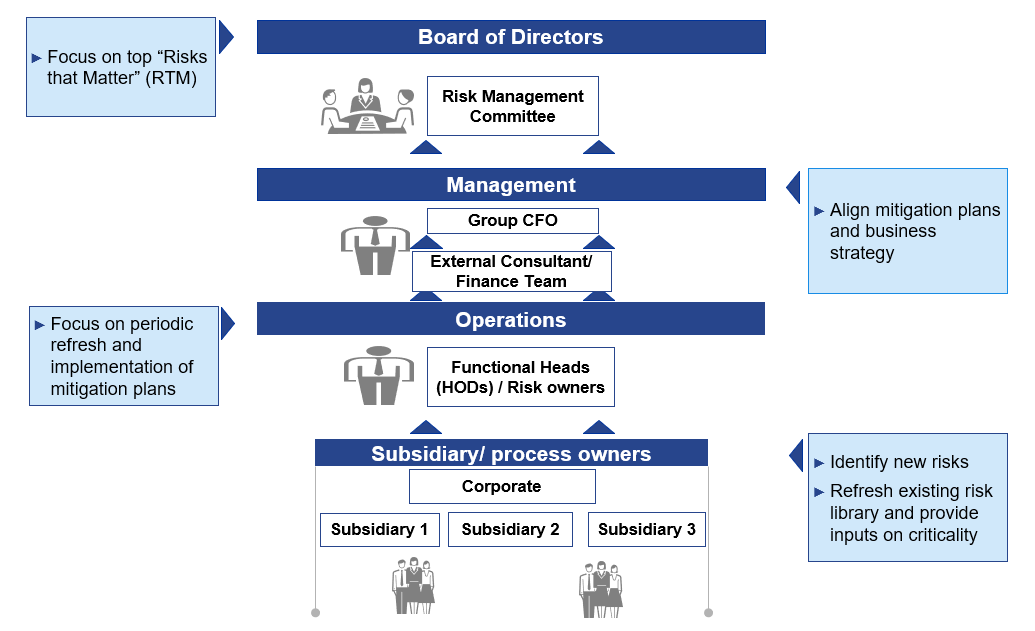
While the series of Risk Management activities to be performed remains the same for risks that arise from routine and non-routine activities/events, the frequency, extent, and review for risk mitigation may significantly vary.
The benefits of Enterprise Risk Management to SecureXcel are listed below:
- Increase the range of opportunities: By considering all reasonable possibilities—both positive and negative aspects of risk—management can identify opportunities for SecureXcel, and unique challenges associated with current and future opportunities.
- Increase positive outcomes and advantages while reducing negative surprises: Enterprise Risk Management allows SecureXcel to improve its ability to identify risks and establish appropriate responses, increasing positive outcomes while reducing negative surprises and related costs or losses.
- Identify and manage SecureXcel-wide risks: SecureXcel may face a myriad of risks that can impact many parts of the Company. Sometimes a risk can originate in one part of SecureXcel but affect a different part. Management shall identify and manage these SecureXcel wide risks to sustain and improve performance.
- Reduce performance variability: The challenge is less about surprises and losses, and more about performance variability. Performing ahead of schedule or beyond expectations may cause as much concern as performing below expectations. This shall help SecureXcel to prepare for any adverse events in future.
- Improve resource deployment: Obtaining robust information on risk allows management to assess overall resource needs and helps to optimize resource allocation.
3 Detailed Risk Management Procedures
Risk procedures are divided into following sections.
- Section 3.1 Risks Originating from Routine Business Activities & Operations
- Section 3.2. Risks Originating from Non-routine Business Activities & Operations
- Section 3.3 Change in Risk Management
- Section 3.4 Exception Management Reporting
3.1 Risks Originating from Routine Business Activities & Operations:
Annual Risk Assessment
The Company performs an annual risk assessment that coincides with its business planning exercise.
The annual business plan sets a good context to identify and prioritize risks. Once the risks have been prioritized, a risk competency scan is performed to identify existing management strategies to address the Risks That Matter (RTMs).
Improvement opportunities to enhance risk mitigation are identified. The total of existing management strategies and improvement opportunities is documented as a formal Risk Management plan for the RTM. As part of this exercise, the assessment (of prioritized risks and their mitigation strategies) is presented to the Risk Management Committee for its consideration and review.
The risk assessment is coordinated by the Designated team by Management or External Risk Management Consultant across operational and strategic risks. The results of the risk assessment are owned by the respective risk owners.
Quarterly Risk Refresh and Reporting
On a quarterly basis, the risk owner/BU/Function Head formally reports on Risk Management within his area of operation. The purpose of this reporting is to assess how well the RTMs are being managed and if any additional RTMs have emerged that can adversely affect business operations.
The risk report includes:
- Performance of the function on managing its RTMs in the light of the mitigation strategies and risk MIS
- Identification of any additional RTMs that has emerged post the annual risk assessment; and
- Definition of the mitigation strategy for the new RTM.
The reporting process is coordinated by the risk owners for the unit. The results of this exercise are compiled by Designated team by Management or External Risk Management Consultant and are made available for review by the Management and the Risk Management Committee. Refer to Annexure 2 for the ‘Risk Management Activity Calendar’ illustrates how the Risk Management activities are operationalized at the Company. SecureXcel can outsource this process to an external consultant.
The following section details the Risk Management procedures for routine business transactions/operations:
3.1.1. Set the Context
| Objective | Lay down the objectives that the Company seeks to achieve. |
|---|---|
| Responsibility | Inputs from: Risk Management Committee, Executive Management, Function/BU Head, Subsidiary BU Heads Compiled by: Designated team by Management or External Risk Management Consultant |
| Frequency | Annual assessment |
| Output | Goal/context setting |
| Enablers | SecureXcel Strategy document |
The purpose of establishing the context is to customize the risk management process, enabling effective risk assessment and appropriate risk treatment. Scope, context, and criteria involve defining the scope of the process and understanding the external and internal context.
This step involves understanding the vision, goals, business strategy and structure of SecureXcel to identify its objectives and areas that it seeks to safeguard.
Enterprise Risk Management shall not create SecureXcel’s strategy, but it influences its development. SecureXcel integrates Enterprise Risk Management practices into setting the strategy and provides management with the risk information it needs to consider alternative strategies and, ultimately, to adopt a chosen strategy.
Designated team by Management or External Risk Management Consultant obtains an understanding of the business objectives and management priorities through discussions with the Risk Management Committee and the Executive Management. The objectives and priorities set the background for identifying and prioritizing risks.
| Sr. No | Step | Detailed Procedure | Responsibility |
|---|---|---|---|
| 1 | Define Risk Assessment scope | The SecureXcel should define the scope of its risk management activities. As the risk management process may be applied at different levels (e.g. strategic, operational, program, project, or other activities), it is important to be clear about the scope under consideration, the relevant objectives to be considered and their alignment with SecureXcel objectives. Determine the scope of risk identification and assessment activities for the year. Review anticipated business activities for the coming year and determine if any changes in internal, external or Risk Management context should trigger a re-evaluation of existing risks or identification of new emerging risks. The context for risk management encompasses the external and internal environment in which the SecureXcel pursues its objectives. This context should be based on a thorough understanding of the SecureXcel's operating environment and should be tailored to the specific activity under consideration. This understanding is crucial because: - Risk management is conducted within the framework of the SecureXcel's objectives and operations. - SecureXcel factors can present risks. - The objectives of the SecureXcel as a whole may influence the purpose and scope of the risk management process. Considerations when planning the approach include: - Objectives and decisions to be made. - Expected outcomes. - Time, location, inclusions, and exclusions - Risk assessment tools. - Required resources, responsibilities, and records. - Relationships with other projects | Designated team by Management or External Risk Management Consultant |
| 2 | Evaluate Internal, External and Management context | Gather documents articulating the SecureXcel’s competitive environment, strategic objectives, SecureXcel structure, and existing Risk Management Framework and capability. Consider changes in Internal, external and management context. Consider the effect that business context has on SecureXcel’s risk profile may be viewed in three stages: past, present, and future performance. Looking back at past performance can provide SecureXcel with valuable information to use in shaping its risk profiles. Looking at current performance can show how current trends, relationships, and other factors are affecting the risk profile. And by thinking about what these factors will look like in the future, SecureXcel can consider how its risk profile might evolve with where it is heading or wants to head. Analyze inputs for impacts to all aspects of the Risk Management program such as: - Policies - Roles and responsibilities - Risk appetite. - Risk Framework - Risk categories. - Risk Management processes. - Risk themselves | Heads of Departments Risk Owners Designated team by Management or External Risk Management Consultant |
| 3 | Evaluate & Update Risk appetite criteria and ERM policies | Risk appetite can be defined as the level of risk that SecureXcel is willing to accept in pursuit of its objectives, considering its overall risk tolerance. The procedures outline the process for developing or revising the risk appetite statements that reflect SecureXcel stance on various categories of risks. Review the risk appetite, impact scale, likelihood, Management preparedness, and velocity and determine if it still reflects SecureXcel’s vision, mission, and priorities. Review SecureXcel overall risk tolerance level and articulate the desired balance between risk-taking and risk avoidance. SecureXcel shall consider following (but limited to) parameters to help frame or revise its risk appetite metrics and indicators or statements that reflect the SecureXcel's stance on various categories of risks. Strategic parameters, such as new solutions or products to pursue or avoid, the investment for capital expenditures, and merger and acquisition activity. Financial parameters, such as the maximum acceptable variation in financial performance, return on assets or risk-adjusted return on capital, target debt rating, and target debt/equity ratio. Operating parameters, such as environmental requirements, safety targets, quality targets, and customer concentrations. The development of risk appetite should align with the development of strategy, business plans and objectives, otherwise, it may appear that goals and priorities are conflicting. Refer to the format of the risk appetite statement in Annexure 13 Perform an annual review of the risk appetite to ensure its continued relevance and effectiveness. Review the appropriateness of the heat map and 2X2 action matrix quadrants designated as Critical, High, Moderate, and Low. Also, review the residual risk class matrix as defined in Annexure 3, Annexure 4 and Annexure 8. Communicate to Designated team by Management or External Risk Management Consultant any change in risk rating criteria so that the risks can be reassessed to be repositioned within SecureXcel. Submit proposed changes to risk policies to Designated team by Management or External Risk Management Consultant, Management and RMC for their review and approval. | Heads of Departments Risk owners. Designated team by Management or External Risk Management Consultant Management RMC |
| 4 | Approve the criteria and policies | The SecureXcel must define its risk appetite and tolerance, aligning with its objectives. It should establish criteria for evaluating risks and supporting decision-making, which should be consistent with the risk management framework and tailored to the activity's purpose and scope. These criteria should reflect the SecureXcel's values, objectives, and resources, and align with its risk management policies. They should also consider stakeholder views and legal obligations. Risk criteria should be set at the start of the risk assessment process but should be flexible and subject to ongoing review and adjustment. Factors to consider when setting risk criteria include the nature of uncertainties affecting objectives, how consequences and likelihood are measured, time considerations, consistency in measurement, determining risk levels, considering multiple risks, and the SecureXcel's capacity. Designated team by Management or External Risk Management Consultant review the proposed policy and risk criteria revisions. Provide comments and feedback to be communicated to the functions or subsidiary. Approve agreed revisions to criteria and policy depending on required changes. | Designated team by Management or External Risk Management Consultant Risk Management Committee |
3.1.2. Risk identification.
| Objective | Identify and compile the potential threats to the business and its operations |
|---|---|
| Responsibility | Prepared by: Business Unit/Function Head Compiled by: Designated team by Management or External Risk Management Consultant (annual), Risk Owner of the function (quarterly) Reviewed by: Risk Management Committee |
| Frequency | - Annual update to risk profile - Quarterly risk refresh |
| Output | Risk Register profiling the risks for the area |
| Enablers | Risk Classification Framework Risk Register Template |
This step involves understanding and listing the potential threats that may affect the realization of the business objectives or priorities. This is either in the form of a risk (negative event) or an opportunity (positive event). The risk identification process takes into consideration both internal and external events (global, regional, and local) by following the below-mentioned procedure.
Annually, a risk profile for the business/function is prepared based on discussions with key management personnel. Existing Risk Registers and management reports serve as a baseline for this exercise. This Risk profile/Register is revisited quarterly by SecureXcel (Designated team by Management or external consultant) to identify any new risk event that can adversely impact business objectives.
Risks that are identified are documented in a standard template called ‘Risk Register’. The Risk Register details the risk, its classification, its potential area of impact and functions that may play a role in managing it. SecureXcel uses a ‘Risk Classification Framework’ to create a common understanding of risks and to differentiate between the risk, its causes, and eventual effects.
The quality and completeness of the risk identification is the responsibility of the Management for the Function/BU. While Designated team by Management or External Risk Management Consultant plays an active role in facilitating the annual risk exercise, the risk owners for the BU/Function play a predominant role in coordinating the quarterly risk assessment and reporting.
The purpose of risk identification is to find, recognize and describe risks that might help or prevent SecureXcel achieving its objectives. Relevant, appropriate, and up-to-date information is important in identifying risks. The objective of this step is to:
- Identify a comprehensive list of risks and events that might impact the achievement of strategic objectives.
- Identify sources of risk, areas of impact, events, and their causes and potential consequences
- Describe identified risk.
The detailed procedure is documented below.
| Sr. No | Step | Detailed Procedure | Responsibility |
|---|---|---|---|
| 1 | Research and identify emerging risks | Identify new and emerging risks, or changes in existing risks (upside and downside risk, external risks) and known risks evolving in terms of impact and likelihood. Identify those risks that are likely to disrupt operations and affect the reasonable expectation of achieving strategy and business objectives. Embed identifying opportunities in identifying the risks. Where opportunities are identified, they should be communicated through SecureXcel to be considered as part of setting strategy and business objectives. Research for such risks can be done using various methods such as: - Subscriptions to industry and Risk Management publications - Joining industry and Risk Management consortia to share information and learn emerging risks. - Scenario analysis of leading SecureXcel and companies and perform scenario analysis exercises periodically. - Conduct risk identification meetings through different techniques. - Cognitive Computing and data analytics - Data Tracking - Interviews - Brainstorm sessions and workshops. - Checklists - Flowcharts - Questionaries and surveys - Leading event indicators and escalation triggers - Process analysis. Broad areas for identifying the risks are mentioned in Annexure 1.2 ‘Illustrative Risk Classification Framework’. For example, for related party transactions (RPTs), Process Owners need to be aware of SecureXcel’s framework and policies, identify relevant stakeholders involved in RPTs and gather all necessary documentation, Assess SecureXcel's RPT definitions and policies, then identify key risks associated with RPTs, such as conflicts of interest and regulatory compliances. Evaluate existing risk controls and conduct a comprehensive risk assessment for each identified risk. Collaborate with stakeholders to develop risk mitigation strategies, establish a monitoring mechanism, and regularly review and report on the RPT process and Risk Management practices. Below are the Illustrative approaches tabulated below which can be used by the risk owners or Designated team by Management or External Risk Management Consultant for identifying risks. When identifying risks, SecureXcel shall aim to precisely describe the risk itself, rather than other considerations of that risk, such as the root causes of the risk, the potential impacts of the risk, or the effect of the risk being poorly implemented. SecureXcel employees are encouraged to describe risks by using a standard sentence structure. Here are two possible approaches: - The possibility of [describe potential occurrence or circumstance] and the associated impacts on [describe specific business objectives set by SecureXcel] - The risk to [describe the category set by SecureXcel] relating to [describe the possible occurrence or circumstance] and [describe the related impact] | Heads of Departments Risk Owner Designated team by Management or External Risk Management Consultant |
| 2 | Review Corporate Risk Register, and departmental Risk Register for new, changes, and obsolete risks | Review the risk assessment scope to identify business activities and risk types on which to focus the risk identification and review activities. Identify new risks, obsolete and updates in risk in terms of their impact or likelihood. Update Risk Register with: - New risks - Removing obsolete with reasons Maintain a log of changes made to Risk Register – Enterprise Risk Registers and Operational Risk Register. | Heads of Departments Risk Owner |
| 3 | Identify root causes and consequences | The user department shall assist Designated team by Management or External Risk Management Consultant to identify new risks. Identify and quantify the risk's root causes and consequences. Consider the following kind of questions when identifying risks and their root causes: - What could happen? - How could it happen? - Why might it happen? - What might be the impact? - Who can influence the activity? Communicate with staff their roles and responsibilities in identifying root causes and consequences. Review the initial list of root causes and consequences and amend as appropriate. Aggregate risks into potential top risks for SecureXcel. | Heads of Departments Risk Owner |
| 4 | Approve risks and communicate final risks with respective personnel | Provide approval to proceed to risk analysis. Gather feedback on risks and include any missed risks, risk root causes and consequences. Communicate the final list of risks to be analyzed and evaluated. | Designated team by Management or External Risk Management Consultant Risk Management Committee |
| 5 | Guideline for documenting the risk description in the risk register | Risk Description: a. Clear and Concise Language: - Use clear and concise language to describe the risk. - Avoid jargon or technical terms that might be unclear to stakeholders. b. Source of Risk: - Identify the source or origin of the risk. - Specify if the risk is internal (within SecureXcel) or external (outside the SecureXcel). c. Nature of the Risk: - Describe the nature of the risk (e.g., financial, operational, strategic, compliance-related). - Highlight specific events or circumstances that could trigger the risk. d. Dependencies: - Identify any dependencies or interconnected risks. - Consider how the risk may impact or be impacted by other risks. e. Likelihood of Occurrence: - Provide an estimate of the likelihood of the risk occurring (e.g., low, medium, high). - Consider historical data, expert opinions, and any relevant information. f. Potential Consequences: - Outline the potential consequences or outcomes if the risk materializes. - Include both quantitative (financial impact) and qualitative factors. g. Risk Owner: - Assign responsibility for monitoring and managing the risk to a specific individual or team. - Clarify the reporting lines and communication channels. Impact Assessment: a. Financial Impact: - Quantify the potential financial impact of the risk. - Consider both direct and indirect costs associated with the risk. b. Operational Impact: - Assess the impact on day-to-day operations. - Consider disruptions to processes, systems, and personnel. c. Reputation Impact: - Evaluate the potential impact on the SecureXcel's reputation. - Consider customer trust, brand image, and stakeholder perception. d. Regulatory and Legal Impact: - Identify any regulatory or legal implications. - Consider potential fines, lawsuits, or compliance issues. e. Strategic Impact: - Assess the impact on long-term strategic goals. - Consider effects on market position, competitiveness, and growth. Timing of the Risk: a. Event Triggers: - Identify specific events or triggers that may precede or coincide with the occurrence of the risk. - Consider early warning signs or indicators. b. Lead Time: - Estimate the lead time between the identification of early warning signs and the actual occurrence of the risk. - Determine how much time is available for proactive risk management. c. Frequency: - Assess the frequency with which the risk may occur. - Determine if the risk is a one-time event or has a recurring nature. d. Time Sensitivity: - Evaluate the sensitivity of the risk to time. - Determine if the timing of the response is critical for effective mitigation | |
| 6 | Factors to be considered | The SecureXcel can use a range of techniques for identifying uncertainties that may affect one or more objectives. The following factors, and the relationship between these factors, should be considered: - Tangible and intangible sources of risk. - Causes and events. - Threats and opportunities. - Vulnerabilities and capabilities. - Changes in the external and internal context. - Indicators of emerging risks. - Nature and value of assets and resources. - Consequences and their impact on objectives. - Limitations of knowledge and reliability of information. - Time-related factors. - Biases, assumptions, and beliefs of those involved. |
3.1.3. Risk Analysis and Prioritization
| Objective | Identify the critical risks that can adversely impact business operations or the Company or any upside risks. Assessing severity at different levels of SecureXcel |
|---|---|
| Responsibility | Prepared by: Business Unit/Function Head Compiled by: Designated team by Management or External Risk Management Consultant (annual), Risk Owner of the function (quarterly) Reviewed by: Risk Management Committee |
| Frequency | - Annual prioritization - Quarterly review of the risk profile |
| Output | Prioritized “Risks That Matter” (‘RTM’) |
| Enablers | Mitigation control effectiveness rating (Annexure 7) Residual risk class and Required action matrix (Annexure 8) |
The purpose of risk analysis is to comprehend the nature of risk and its characteristics including, where appropriate, the level of risk. Risk analysis involves a detailed consideration of uncertainties, risk sources, consequences, likelihood, events, scenarios, controls, and their effectiveness. An event can have multiple causes and consequences and can affect multiple objectives.
Risk analysis provides an input to risk evaluation, to decisions on whether risk needs to be treated and how, and on the most appropriate risk treatment strategy and methods. The results provide insight for decisions, where choices are being made, and the options involve different types and levels of risk.
This step involves identifying and selecting critical risks from the Risk Register. The objective of risk analysis is to comprehend the nature of risk and its characteristics including, where appropriate, the level of risk. Risk analysis involves a detailed consideration of uncertainties, risk sources, consequences, likelihood, events, scenarios, controls, and their effectiveness. An event can have multiple causes and consequences and can affect multiple objectives. Risk analysis can be undertaken with varying degrees of detail and complexity, depending on the purpose of the analysis, the availability and reliability of information, and the resources available. Analysis techniques can be qualitative, quantitative or a combination of these, depending on the circumstances and intendeds use.
Risks identified and included in SecureXcel’s Risk Register are assessed to understand the severity of each to the achievement of SecureXcel’s strategy and business objectives. Risk assessments inform the selection of risk responses. Given the severity of the risks identified, management decides on the resources and capabilities to deploy for the risk to remain within SecureXcel’s risk appetite.
An inherent risk assessment is performed for the risks i.e., the impact and likelihood of occurrence is evaluated assuming that controls are not in existence. This allows the business to focus on the most important risks, ‘Risks That Matter’ (RTM). For the RTMs, a separate assessment of the effectiveness of risk mitigation is provided as part of risk reporting.
Before initiating the annual risk prioritization exercise, Designated team by Management or External Risk Management Consultant seeks feedback from the Risk Management Committee on its areas of concern. The ‘Designated team by Management or External Risk Management Consultant’ facilitates the prioritization of risks for the different functions by involving the Function Heads and risk owners. Risk rating criteria should be used as enablers for this exercise. The results of the annual risk prioritization are subject to review, change and approval by the BU/Function Head.
Every quarter, the BU/Function Head would evaluate the relative importance of emerging/existing risk events. This prioritization/refresh would be facilitated by the Designated team by Management or External Risk Management Consultant for the function/BU. Any additional RTM that emerges would be reported as part of the ‘risk reporting’ pack.
Procedures for risk analysis and prioritization
| Sr. No | Step | Detailed Procedure | Responsibility |
|---|---|---|---|
| 1 | Assess the impact of risk event | Risk analysis can be undertaken with varying degrees of detail and complexity, depending on the purpose of the analysis, the availability and reliability of information, and the resources available. Analysis techniques can be qualitative, quantitative or a combination of these, depending on the circumstances and intended use. Assess impact based on inherent risks (assuming that there are no controls in place) Assess the impact rating of a particular risk using a series of descriptors like: Qualitative assessment approaches, such as interviews, workshops, surveys, and benchmarking, should be used when it is neither practicable nor cost-effective to obtain sufficient data for quantification. Qualitative assessments are more efficient to complete; however, there are limitations in the ability to identify correlations or perform a cost-benefit analysis. Quantitative assessment approaches, such as modelling, decision trees, Monte Carlo simulations, etc., allow for increased granularity and precision and support a cost-benefit analysis. Consequently, quantitative approaches are typically used in more complex and sophisticated activities to supplement qualitative techniques. Probabilistic models (e.g., value at risk, cash flow at risk, operational loss distributions) that associate a range of events and the resulting impact with the likelihood of those events based on certain assumptions. Understanding how each risk factor could vary and impact cash flow, for example, allows management to better measure and manage the risk. Non-probabilistic models (e.g., sensitivity analysis, scenario analysis) use subjective assumptions to estimate the impact of events without quantifying an associated likelihood on a business objective. For example, scenario analysis allows management to understand the impact on a business objective to increase profitability under different scenarios, such as a competitor releasing a new product, a disruption in the supply chain, or an increase in product costs. Management may rely on a degree of judgment and expertise when conducting the modelling. Regardless of the approach used, any assumptions should be clearly stated during the analysis. Risk analysis should consider factors such as: - the likelihood of events and consequences. - the nature and magnitude of consequences. - complexity and connectivity. - time-related factors and volatility. - the effectiveness of existing controls. - sensitivity and confidence levels. | Heads of Departments Risk Owners Designated team by Management or External Risk Management Consultant |
| 2 | Defining the likelihood of occurrence of risk event and consequence | Likelihood: The possibility of a risk occurring. This may be expressed in terms of the probability or frequency of occurring. Assess the likelihood of the risk occurring that is described as: - Rare - Unlikely - Possible - Likely or - Almost certain Impact: Result or effect of risk. There may be a range of possible impacts associated with risk. The impact of a risk may be positive or negative relative to the strategy or business objectives. Assess the consequence or impact of the risk event, which if occurred is described as insignificant, minor, moderate, major, or catastrophic. SecureXcel Management can change the rating scale based on requirements defined in the setting context. Refer to Annexure 3 for the rating scale. | Heads of Departments Risk Owners Designated team by Management or External Risk Management Consultant |
| 3 | Determine inherent risk rating | Inherent risk is the risk to SecureXcel in the absence of any direct or focused actions by management to alter its severity. Rate the level of inherent risk using risk matrix (refer to Annexure 3) to assess the likelihood and consequence levels. The risk rating is computed using the below formula: Risk impact x risk likelihood = risk rating Update the Risk Register with the risk impact and risk likelihood rating | Heads of Departments Risk Owners Designated team by Management or External Risk Management Consultant |
| 4 | Assess existing controls measures for risks | Assess the controls and measures (practices and policies) that the department has already has in place, that reduce the level of the risk identified above. These mitigating effects, processes or key controls should be identified, and documented. By this task, SecureXcel can assess how effective the existing controls are in managing risks. Determine what controls already exist which would affect the level of risk. These controls could either reduce the likelihood of the risk occurring or reduce the impact should the risk occur. A decision is then made as to whether this residual risk is acceptable or unacceptable. The assessment aims to arrive at a prioritized list of risks that can be flagged for mitigation plan treatment. Define the existing Mitigation control effectiveness as per Annexure 7 | Heads of Departments Risk Owners Designated team by Management or External Risk Management Consultant |
| 5 | Arrive at the actual residual risk rating | Prepare a ‘residual risk rating matrix’ for all risks identified in the above steps after considering the existing control measures. Rate the level of residual risk using risk matrix (refer to Annexure 3) to assess the likelihood and consequence levels. The risk rating is computed using the below formula: Risk impact x risk likelihood = risk Rating. Update the Risk Register with the risk impact and risk likelihood rating. Assess the overall preparedness of SecureXcel’s management at mitigating the likelihood and/or impact of risk and provide the rating as per Annexure 3. Assess the risk velocity (how soon or when) that could materialize at this level of impact and provide the rating as per Annexure 3. Based on the residual risk rating matrix, determine the ‘Residual risk class and the required ‘action needed’ for the risk which shall be performed during the risk mitigation phase. Refer to Annexure 8. Target residual risk is the amount of risk that SecureXcel prefers to assume in the pursuit of its strategy and business objectives, knowing that management will implement, or has implemented, direct or focused actions to alter the severity of the risk. | Heads of Departments Risk Owners |
| 6 | Residual risk acceptable or Tolerable | Risk evaluation involves comparing the results of the risk analysis with the established risk criteria to determine where additional action is required. This can lead to a decision to do nothing further, consider risk treatment options, undertake further analysis to better understand the risk, maintain existing controls, reconsider objectives. If residual risk is acceptable or tolerable, no further action is needed. The following circumstances could indicate that a risk is acceptable: - No treatment is available. - Treatment costs are prohibitive. - The level of risk is low and does not warrant using resources to treat. - The opportunities involved significantly outweigh the risks. Actual residual risk is the risk remaining after management has taken action to alter its severity. Actual residual risk should be equal to or less than the target residual risk. Where actual residual risk exceeds target risk, additional actions should be identified that allow management to alter risk severity further. | Designated team by Management or External Risk Management Consultant |
| 7 | Aggregate and prioritize residual risks | The prioritization of risks, given their severity, the importance of the corresponding business objective, and SecureXcel’s risk appetite helps management in its decision-making. Risk prioritization occurs at all levels of SecureXcel, and different risks may be assigned different priorities at different levels. For example, high-priority risks at the operating level may be evaluated as low-priority risks at SecureXcel level. Management should also compare risk appetite when prioritizing risks. Risks that result in SecureXcel approaching the risk appetite for a specific business objective are typically given higher priority. Prioritization considers the severity of the risk compared to risk appetite. Greater priority may be given to those risks likely to approach or exceed risk appetite. Factors that may be considered while prioritization the risk. - Adaptability: The capacity of SecureXcel to adapt and respond to risks - Complexity: The scope and nature of a risk to SecureXcel’s success. The interdependency of risks will typically increase their complexity. - Velocity: The speed at which a risk impacts SecureXcel. The velocity may move SecureXcel away from the acceptable variation in performance. - Persistence: How long a risk impacts SecureXcel - Recovery: The capacity of SecureXcel to return to tolerance. Recovery excludes the time taken to return to tolerance, which is considered part of persistence, not recovery. Heat Map: Plot the risks on the risk assessment map based on defined impact and likelihood scales (Step 2) for SecureXcel and assign risk classification based on risk rating into Significant, High, Medium, and low and update the Risk Register. 2X2 Actionable Matrix: Also, Prepare an Actionable 2X2 matrix considering impact (Step 5), likelihood (Step 5), Management preparedness (Step 5) and Velocity (Step 5) scales for SecureXcel and assign risk classification based on risk rating into Test, Improve, Optimize, and Monitor and update Risk Register. Refer to the Risk Action Matrix in Annexure 4 . Document the KRIs for Key risks in Risk Register as detailed in Annexure 6. This will form the basis for risk monitoring plans. They are usually quantitative but can be qualitative. | Heads of Departments Risk Owners Designated team by Management or External Risk Management Consultant |
| 8 | Set up escalation and monitoring protocol | Identify if management action is required for various risk ratings. Significant and high risks are to be escalated to Management for appropriate consideration. | Designated team by Management or External Risk Management Consultant |
| 9 | Categorize risks | Classify risks according to the primary root cause. Risks are classified using the following criteria: - Financial risks - Operations risks - Regulatory/Compliance risks - Strategic risks Refer to Annexure 1 and Annexure 1.1 for definitions of the risk classification | Designated team by Management or External Risk Management Consultant |
| 10 | Identifying Triggers for Reassessment | Identify triggers that will prompt a reassessment of risk like - Changes in the business context - Changes in the risk appetite - Changes to assumptions underpinning the severity assessment. The severity of the risks and the frequency at which severity may change will inform how often the assessment may be triggered. In case of any requirement arises for reassessment, risk owners shall follow the same process as detailed above. | Designated team by Management or External Risk Management Consultant |
3.1.4. Risk Mitigation
| Objective | Identify the mitigation plan for addressing the Risks That Matter |
|---|---|
| Responsibility | Prepared by: Designated Risk Owner in the BU/Function Approved by: Business Unit/Function Head Compiled by: Designated team by Management or External Risk Management Consultant Reviewed by: Risk Management Committee |
| Frequency | Annual preparation and assignment of the mitigation plans On a quarterly basis, update existing mitigation plans (if applicable) and prepare mitigation plans for any new RTM/s |
| Output | Mitigation plan with timelines and responsibilities |
| Enablers | Risk Treatment Action Plan |
The purpose of risk mitigation is to select and implement options for addressing and treating the risk. Risk treatment involves an iterative process of:
- formulating and selecting risk treatment options.
- planning and implementing risk treatment.
- assessing the effectiveness of that treatment.
- deciding whether the remaining risk is acceptable.
- if not acceptable, taking further treatment.
This step involves preparing the risk response plan for managing the RTMs and restricting their impact to a tolerable level.
The entire process is broken down into the following activities:
- Root cause analysis to identify the reasons and drivers for the existence of the risk.
- Development of mitigation plans with defined ownership and implementation timelines
- Assessing the existing processes and activities presently undertaken to address the risks.
- In view of the root causes, identify any gaps in the existing controls environment.
- Designing additional mitigation strategies to address the risk; and
- Documenting a mitigation plan with timelines and responsibilities (including existing and proposed activities)
The BU/Function Head has the responsibility for the quality and completeness of the mitigation plans. He/she shall nominate risk owner to identify the root causes and assess existing management controls and improvement opportunities.
This person documents the mitigation strategy (considering existing and proposed activities) with timelines and responsibilities. The Designated team by Management or External Risk Management Consultant would facilitate the documentation of the mitigation plans. All mitigation plans shall be submitted to the Risk Management Committee for review and consideration.
Detailed procedures for risk mitigation are provided below.
| Sr. No | Step | Detailed Procedure | Responsibility |
|---|---|---|---|
| 1 | Type of Risk Treatment Options | Selecting the most appropriate risk treatment option(s) involves balancing the potential benefits derived in relation to the achievement of the objectives against costs, effort, or disadvantages of implementation. Risk treatment options are not necessarily mutually exclusive or appropriate in all circumstances. Review risks listed in the prioritized list of risks requiring treatment. These categories of risk responses require that the risk be managed within the business context, business objectives, performance targets, and SecureXcel’s risk appetite. Following are the risk responses. - Risk avoidance ends the activity from which the risk arises. Avoidance typically suggests no response would reduce the risk to an acceptable level. (e.g., discontinuing a product line or selling a subsidiary). Choosing avoidance suggests that SecureXcel was not able to identify a response that would reduce the risk to an acceptable level of severity. - Risk-retention accepts the risk of an activity. No action is taken to change the severity of the risk. This response is appropriate when the risk to strategy and business objectives is already within risk appetite. The risk that is outside SecureXcel’s risk appetite and that Management seeks to accept will require approval from Risk Management Committee - Risk reduction (mitigation) lowers the level of risk associated with an activity. Action is taken to reduce the impact of the risk so that it is within the target residual risk profile and risk appetite for example, the risk of systems penetration can be reduced by maintaining an effective information security function within SecureXcel. - Risk sharing some loss potential to another party. Action is taken to reduce the severity of the risk by transferring or otherwise sharing a portion of the risk. Examples are insurance, hedging, entering joint ventures, outsourcing an activity, and contractual agreements with customers, vendors, or other business partners. As with the reduced response, sharing risk lowers residual risk in alignment with risk appetite. - Risk pursuit is an action taken to accept increased risk to improve performance without exceeding acceptable tolerance. Action is taken that accepts increased risk to achieve improved performance. This may involve adopting more aggressive growth strategies, expanding operations, or developing new products and services. When choosing to pursue risk, management understands the nature and extent of any changes required to achieve desired performance while not exceeding the boundaries of acceptable tolerance. Review existing risk treatment strategies and controls and insurance policies and analyze their effectiveness. Identify and document risk treatment options for those risk root causes and consequences selected | Heads of Departments Risk Owners |
| 3 | Selecting and Deploying Risk Responses | The following factors should be considered for selecting the risk response. - Business context: Risk responses should be selected or tailored to the industry, geographic footprint, regulatory environment, operating structure, or other factors. - Costs and benefits: Anticipated costs and benefits are generally commensurate with the severity and prioritization of the risk. - Obligations and expectations: Risk response addresses generally accepted industry standards, stakeholder expectations, and alignment with the mission and vision of SecureXcel. - Prioritization of risk: The priority assigned to the risk informs the allocation of resources. Risk responses that have large implementation costs (e.g., system upgrades, increases in personnel) for lower-priority risks need to be carefully considered and may not be appropriate given the assessed priority. - Risk appetite: Risk response either brings risk within the risk appetite of SecureXcel or maintains its status. Management identifies the response that brings residual risk to within the appetite. This may be, for example, a combination of purchasing insurance and implementing internal responses to reduce the risk to a range of tolerance. - Risk severity: Risk response should reflect the size, scope, and nature of the risk and its impact on SecureXcel. For example, in a transaction or production environment, where risks are driven by changes in volume, the proposed response is scaled to accommodate increased activity. If there are no treatment options available or if treatment options do not sufficiently modify the risk, the risk should be recorded and kept under ongoing review. Decision makers and other stakeholders should be aware of the nature and extent of the remaining risk after risk treatment. The remaining risk should be documented and subjected to monitoring, review and, where appropriate, further treatment. | Heads of Departments Risk Owners |
| 4 | Assess Risk Treatment Options | Determine the cost and benefits of implementing the various risk treatment options. Identify the qualitative impacts that would be reduced or eliminated by the various risk treatment options. Residual risk is the risk that remains after risk responses are executed. Calculate the residual risk for selected risk treatment option scenarios. This is accomplished by estimating what the likelihoods (probabilities) and impacts (severities) of the risk root causes and consequences are expected to be after the selected risk treatment is put in place. Compare the residual risk calculation to the risk tolerance level. If the residual risk still exceeds the risk tolerance level, then consider additional risk treatment options until the estimated residual risk is reduced below the risk tolerance level. Select the most cost-effective combination of risk treatment options that reduce the estimated risk to an acceptable level below the risk tolerance. If this cannot be accomplished cost-effectively, then consider eliminating the risk by ceasing to perform the business activity or transferring the risk. It will usually not be cost-effective or even desirable to implement all possible risk treatments. It is, however, necessary to choose, prioritize and implement the most appropriate combination of risk treatments. Assess whether the treatment option is: - Likely to be accepted by all relevant stakeholders? - Easy to implement, is not difficult to administer, and does not contradict other treatments that may be adopted? - Effects are continuous and sustainable, and whether the same results can be achieved at a lower cost by other means? - Lead to additional benefits in other areas, and will it expose SecureXcel to new risks? - Treatment option to be approved by the Head of the department? | Heads of Departments Risk Owners |
| 5 | Review Risk Treatment Options | Develop an overall risk treatment strategy. The development of an overall treatment strategy should be a top-down process, driven jointly by the need to achieve business objectives while controlling uncertainty to the extent that it is desirable. Consult broadly about risk treatment with the User Department and ensure they are acceptable to those involved in implementation. Communicate the overall risk treatment plan. Review risk treatment plans for alignment with the strategy. Share best practices across teams and suggest alternatives. Review proposed risk treatment strategy and selected risk treatment options and cost‐benefit analysis submitted by risk owners. When justifying risk treatments, consider not only economic factors but also the SecureXcel's obligations, commitments, and stakeholder perspectives. Choose treatments based on objectives, risk criteria, and resources. Factor in stakeholders' values and perceptions when selecting treatments. Communication and consultation methods should be appropriate for different stakeholders, as some treatments may be more acceptable to certain groups. Even well-designed treatments may not produce expected results and could have unintended consequences. Monitoring and review are crucial to ensure treatments remain effective. Implementing risk treatments can introduce new risks that require management. | Risk Owners Designated team by Management or External Risk Management consultant |
| 6 | Prepare a Risk Treatment Plan | Develop a detailed risk treatment action plan including the person responsible for implementing the risk treatment, the primary activities, required resources, schedule, budget, reviewer, and status. The information provided in the treatment plan should include: - Rationale for selection of the treatment options, including the expected benefits to be gained. - Accountable and responsible for approving and implementing the plan. - Proposed actions. - Resources required, including contingencies. - Performance measures. - Constraints. - Required reporting and monitoring. - Timelines | Heads of Departments Risk Owners |
| 7 | Implement Risk Treatment Plans | Initiate the implementation of the risk treatment. Treatment plans should be integrated into the management plans and processes of the SecureXcel, in consultation with appropriate stakeholders. The person responsible for implementation should take the actions outlined in the treatment plan, report progress to the reviewer and other identified stakeholders, and manage the implementation within the agreed budget and schedule. Once the implementation is complete, Designated team by Management or External Risk Management Consultant should be informed. Update information in Risk Register regarding risk treatment progress. As the risk treatment plans are implemented, update information regarding the root causes and impacts of the risks including annual frequencies, probabilities, impacts, and existing treatment strategies and controls. | Heads of Departments Risk Owners |
| 8 | Documentation of risk mitigation plan | Risk Mitigation structure (each point should be in one sentence only) Outline detailed strategies for mitigating each identified risk articulating the following. 1. Objective of the mitigation plan: - 2. Specifying actions to achieve the above objective: - (like step 1, step 2, step 3 etc...) 3. Resource requirements a) Financial Resources b) Human Resources c) Technological resources d) Other resources 4. Key Risk indicators for monitoring and reporting the progress of mitigation plan. 5. Responsible Person 6. Timelines A Mitigation plan should be able to answer the following questions. 1. Will the plan reduce the risk to an acceptable level? 2. Whether an alternative is established if in case the primary mitigation plan fails? 3. Is it likely to be accepted by all relevant stakeholders? 4. Is it easy to implement and not difficult to administer, and does not contradict other treatments that may be adopted? 5. whether a cost-benefit analysis for each mitigation strategy, demonstrating the economic rationale behind the proposed actions is performed? 6. Are the effects continuous and sustainable, and whether the same results can be achieved at lower cost by other means? 7. Does it lead to additional benefits in other areas, and will it expose SecureXcel to new risks? 8. Identify and quantify the objectives which shall be achieved in the mitigation plan. Consider the following kind of questions when quantifying: i. What could happen? ii. How could it happen? iii. Why might it happen? iv. What might be the impact? v. Who can influence the activity? |
3.1.5. Risk Monitoring and Reporting
| Objective | Evaluate the effectiveness of Risk Management at the BU/Function |
|---|---|
| Responsibility | Prepared by: Designated Risk Owner in the BU/Function Approved by: Business Unit/Function Head Compiled by: For the Function/BU: Designated team by Management or External Risk Management Consultant Overall compilation for the Company – Designated team by Management or External Risk Management Consultant Reviewed by: Risk Management Committee |
| Frequency | Quarterly reporting |
| Output | Risk Dashboard |
| Enablers | Risk Dashboard template |
The purpose of monitoring and review is to assure and improve the quality and effectiveness of process design, implementation, and outcomes. Ongoing monitoring and periodic review of the risk management process and its outcomes should be a planned part of the risk management process, with responsibilities clearly defined.
Monitoring and review should take place in all stages of the process. Monitoring and review include planning, gathering, and analyzing information, recording results, and providing feedback. The results of monitoring and review should be incorporated throughout the SecureXcel’s performance management, measurement and reporting activities.
This step involves reviewing the results of the Risk Management Framework to assess if risks are well controlled. The risk monitoring and reporting process helps in evaluating:
- Any new RTMs which can adversely impact the business.
- The extent of implementation of the mitigation strategies and efficacy of risk mitigation
1. Monitoring
On a quarterly basis, the Business Unit/Function Head reviews the status of Risk Management. While assessing the risk, the BU/Function Head:
- Assesses if any additional risk has emerged that, is already not considered in the risk profile.
- Assesses if a new risk/another risk that is already documented in the risk profiled should be considered as an RTM.
- Nominates a risk owner for a new RTM and oversees the development of mitigation plans; and
- Assesses the performance of the business in managing the risk for the RTM.
- Reviews the extent to which the mitigation plans have been implemented.
- Based on quantifiable data (where possible), assess if the mitigation plans have delivered the right results in terms of Risk Management
To facilitate the above exercise, the risk owners provide information to the Function/BU head.
The designated risk owner provides a self-assessment of the extent of risk mitigation. This assessment is based on feedback on the implementation of the mitigation plans and review of data (where applicable) with respect to risk performance.
If any risks get converted into actual events, the risk owners or process owners shall report the risk event to the Management and Risk Management Committee in the ‘Risk Incident Reporting’ Template as defined by Management.
- 2. Reporting
The risk management process and its outcomes should be documented and reported through appropriate mechanisms. Recording and reporting aims to:
- communicate risk management activities and outcomes across the SecureXcel.
- provide information for decision-making.
- improve risk management activities.
- assist interaction with stakeholders, including those with responsibility and accountability for risk management activities.
Decisions concerning the creation, retention and handling of documented information should consider, but not be limited to their use, information sensitivity and the external and internal context Reporting is an integral part of the SecureXcel’s governance and should enhance the quality of dialogue with stakeholders and support top management and oversight bodies in meeting their responsibilities. Factors to consider for reporting include, but are not limited to:
- Differing stakeholders and their specific information needs and requirements.
- Cost, frequency, and timeliness of reporting.
- Method of reporting.
- Relevance of information to SecureXcel objectives and decision-making.
The results of the risk assessment are compiled in an ERM risk dashboard as referred to in Annexure 5. The Designated team by Management or External Risk Management Consultant shall support the BU/Function Head in compiling this report.
The ERM risk exposure dashboard is designed to provide an overall risk portfolio perspective of SecureXcel’s top risks. The portfolio perspective communicates the quantified acceptable risk tolerance for each risk, the current risk exposure, the risk mitigation plans (Go-to-Green) to reduce the risk exposure to acceptable risk tolerance levels, and the investments made/needed.
In addition, the portfolio perspective enables the SecureXcel’s overall risk appetite to be considered during risk response planning and resource allocation discussions.
Detailed procedures for preparing Risk Dashboard are provided below.
| Sr. No | Step | Detailed Procedure | Responsibility |
|---|---|---|---|
| 1 | Define the Risk Tolerance | The risk owner assembles relevant individuals to define risk exposure and establish an acceptable risk tolerance. The proposed risk tolerance is reviewed and approved by Risk Management Committee. | Risk Owner Designated team by Management or External Risk Management Consultant |
| 2 | Evaluate if Addition Risk Mitigation is Necessary | The risk owner and Designated team by Management or External Risk Management Consultant collaborate to reassess and analyze the cost-effectiveness of various risk mitigation strategies. | Risk Owner Designated team by Management or External Risk Management Consultant |
| 3 | Evaluate Mitigation Options | Designated team by Management or External Risk Management Consultant use cost/benefit analysis to determine which mitigation options to Action. Risk owner (delegates) to action agreed to risk mitigations. | Risk Owner Designated team by Management or External Risk Management Consultant |
Developing a “Portfolio View”
- a) A portfolio is depicted graphically indicating the types and amount of risk assumed compared to the risk appetite of SecureXcel for each SecureXcel function, strategy, and business objective.
- b) A portfolio view allows management and the board to consider the type, severity, and interdependencies of risks and how they may affect performance.
- c) Using the portfolio view, SecureXcel identifies risks that are severe at SecureXcel level. These may include risks that arise at SecureXcel level as well as transactional, processing-type risks that could disrupt SecureXcel. The same risk across different units may be acceptable for the operating units but taken together may give a different picture.
- d) Developing a portfolio view of the risks related to SecureXcel enables risk-based decision-making and helps set performance targets and manage changes in either the performance or the risk profile. By using the portfolio, SecureXcel management can review:
- Assumptions underpinning the assessment of the severity of risk.
- Behavior of individual risks under stressed conditions
- Interdependencies of risks within the portfolio view
- Effectiveness of existing risk responses
The Designated team by Management or External Risk Management Consultant shall consolidate the risk dashboards across the Company and presents these to the Risk Management Committee for its review and appraisal.
In addition, every quarter, based on a pre-specified calendar, a BU/Function would make a formal presentation to the Risk Management Committee on its Risk Management initiatives and status.
On an annual basis, Designated team by Management, or External Risk Management Consultant (along with such officials as may be directed by the Risk Management Committee) makes a formal presentation on the Risk Management activities to the Risk Management Committee. This shall include:
- An overview of the Risk Management process in place.
- Summary of the Risks That Matter across the Company; and
- Results of Risk Management
| Sr. No | Step | Detailed Procedure | Responsibility |
|---|---|---|---|
| 1 | Prepare Scheduled Reports | Prepare quarterly and annual risk reports. Distribute reports to agreed audience groups according to the agreed schedule. Prepare ad hoc reports for Designated team by Management or External Risk Management Consultant and Risk Management Committee. | Heads of Departments Risk Owners Designated team by Management or External Risk Management Consultant |
| 2 | Review and Respond to Reports | Determine if corrective action needs to be taken, the affected parties, and what communications outside of regular channels might be required. Endorse corrective actions and assist in identifying and deploying cross‐SecureXcel resources to investigate risk events or sudden changes or developing trends. By reviewing Risk Management performance, SecureXcel management may seek answers to questions such as - Has the entity performed as expected and achieved its target? - What risks are occurring that may be affecting performance? - Was the entity taking enough risk to attain its target? - Was the estimate of the amount of risk accurate? | Designated team by Management or External Risk Management Consultant Audit Committee Board of Directors |
| 3 | Manage Risk Management Workflow and Schedule | Maintain a calendar of Risk Management activities for the year beginning with the Establish the Context process. Agree on the calendar with the involved team members. Once the calendar is agreed upon, communicate the schedule, milestones, and expectations. Update calendar at defined intervals as the scope of work is elaborated, for example after the risk assessment scope, risk prioritization, and risk treatment plan are approved. If activities or tasks are not being performed timely or at the required level of quality, then the issue should be raised with the User Department. | Designated team by Management or External Risk Management Consultant |
| 4 | Enhance Capabilities | Monitor emerging Risk Management best practices. Evaluate the efficiency and effectiveness of existing Risk Management processes, tools, and techniques. Develop recommendations for enhancements to SecureXcel’s Risk Management capability including costs and benefits. Involve the User Departments within SecureXcel. Present the recommendations for approval to the Designated team by Management or External Risk Management Consultant, Risk Management Committee and Board of Directors. | Designated team by Management or External Risk Management Consultant |
| 5 | Identify Needs for Stakeholders, Communication, and Training Plans | Review stakeholder analysis from the previous year and determine if the stakeholder groups have changed. Include both internal and external stakeholders. Determine the communication and training needs of each stakeholder group. | Designated team by Management or External Risk Management Consultant Designated team by Management or External Risk Management Consultant |
| 5 | Develop and Deliver Communication Hand Training | Develop a detailed communication plan including the target audience, the sender, the timing, the communication channel (email, newsletter, meeting, agenda items, etc.), the message, and responsibility for developing and managing the delivery of the content. Develop a detailed training plan including the target audience, who will deliver the training, the timing, the instructional method (instructor‐led, self‐study, goal‐based scenario, etc.), the content, and responsibility for developing and managing the delivery of the content. Develop communication and training materials. Deliver the communications and training according to the plans. | Designated team by Management or External Risk Management Consultant |
| 6 | Maintain Risk Management Documentation | Maintain Risk Management documentation. Designated team by Management or External Risk Management Consultant will be responsible for this role. | Designated team by Management or External Risk Management Consultant |
3.2. Risks Originating from Non-routine Business Activities & Operations:
Where the Company undertakes a non-routine activity/transaction, it shall nominate an Executive-in-Charge. The Execute-in-Charge plays the principal role in driving the transaction and managing the associated risks. He/she may seek the support of a dedicated Designated team by Management or external Risk Management Consultant to oversee risk mitigation.
Depending on the nature and value of the transaction, the Board of Directors/Risk Management Committee thereof may prescribe the frequency with which it shall review the results of Risk Management for this activity/transaction.
3.2.1 Setting Context
| Objective | Specify the key objectives for the transaction/activity |
|---|---|
| Responsibility | Prepared by: Executive-in-Charge. Compiled by: Designated team by Management or External Risk Management Consultant Approved by: Board/Committee of the Board of Directors |
| Frequency | One-time assessment before the initiation of the activity |
| Output | Goal/context setting |
| Enablers | - |
This step involves laying down the principal objectives/outcome for the transaction/activity. Risks are identified and prioritized in the context of this objective.
The Executive-in-Charge is responsible for assessing the context. The context set forth for the transaction is reviewed with the Board/Committee of the Board of Directors.
3.2.2 Risk Assessment
| Objective | Identify the key risks for the transaction/activity |
|---|---|
| Responsibility | Prepared by: Executive-in-Charge. Compiled by: Designated team by Management or External Risk Management Consultant Approved by: Board/Committee of the Board of Directors |
| Frequency | - Initial assessment - Reassessment based on such intervals that are prudent. - Final re-assessment before completion of the transaction |
| Output | Risks That Matter |
| Enablers | Risk Classification Framework Risk Rating Criteria |
A cross-functional team (where applicable) would identify potential risks arising from the transaction/activity i.e.:
- 1. Risks/threats that the Company is exposed to because of undertaking the transaction/activity; and
- 2. Potential risks that may impact the successful closure of the activity/transaction.
The Executive-in-Charge would approve this risk profile and identify the critical risks. This listing of RTMs will be presented to the Board / Committee of the Board of Directors for their consideration.
3.2.3 Risk Mitigation
| Objective | Identify the risk response plan |
|---|---|
| Responsibility | Prepared by: Executive-in-Charge. Compiled by: Designated team by Management or External Risk Management Consultant Approved by: Board/Committee of the Board of Directors |
| Frequency | Such intervals as may be prudently specified |
| Output | Risk Mitigation plan with accountability and timelines |
| Enablers | Risk Treatment Action Plan |
Risks That Matter for such activities may manifest themselves before, during or after the execution of the activity. Specific personnel are identified for managing each RTM. The specified personnel would be required to detail the risk response plan for the associated risk within the timeline and with accountability.
The Executive-in-charge of the transaction bears responsibility for managing all RTMs that have been identified. He would be responsible to the Board / Committee of the Board of Directors to oversee the deployment of this plan.
3.2.4 Risk Monitoring and Reporting
| Objective | Report on the effectiveness of Risk Management for the transaction/ activity |
|---|---|
| Responsibility | Prepared by: Designated Risk Owner Approved by: Executive-in-Charge. Compiled by: Risk coordinator (if any) Reviewed by: Board of Directors/Committee thereof |
| Frequency | - Such intervals as may be specified |
| Output | Risk Reporting pack |
| Enablers | Risk Reporting pack template |
- 1. Monitoring
The Designated team by Management or External Risk Management Consultant jointly with risk owner would determine the frequency of the review of the Risk Management action plan. A review of the risk preparedness would be performed and documented by the risk owners and the Executive-in-charge would review these results periodically.
- 2. Reporting
Where such activities need approval from the Board the frequency of review would be agreed thereof with the Board/ its committee. The Executive-in-charge would provide an assessment of Risk Management to the Board/such Committee with the prescribed frequency.
3.3 Change in Risk Management
SecureXcel may anticipate many changes within the setting of strategy and business objectives and performance, but they need to also be aware of the potential for larger, substantial changes that may occur and have a more pronounced effect.
- By embedding continual evaluations into business practices, SecureXcel can systematically identify potential improvements to their Enterprise Risk Management practices.
- Substantial change may lead to new or changed risks and affect key assumptions underpinning strategy.
- Practices for identifying such changes shall be built into business activities and performed continually.
- Changes may be due to the Internal environment or external environment.
SecureXcel’s Designated team by Management or external Risk Management Consultant jointly with risk owners shall identify substantial changes, evaluate their effects, and respond to the changes are iterative processes that can affect several components of Enterprise Risk Management
3.4 Exception Management Reporting
All exceptions to the policy must be approved by the Risk Management Committee and filed at Designated team by Management or External Risk Management Consultant
All exceptions to the procedures to be followed as per the procedures documented in this policy must be approved by the Management. All exceptions should be recorded and approved as per the delegation of authority. All exceptions should be recorded and tracked for closure.
Approval
Level 1- Head of department or enabling function where the risk is identified.
Level 2- Designated team by Management or External Risk Management Consultant
Level 3 – Management
Validity
All exceptions will be provided with a maximum validity period of six (6) months or as per Competent Authority discretion.
4. Risk Management Structure
4.1. Roles and Responsibilities
The Risk Management SecureXcel at SecureXcel comprises the following:
- 1. Primary role
- a) Board of Directors (BoD)
- b) Risk Management Committee
- c) Management
- d) BU / Function Head
- e) Executive-in-Charge (for non-routine transactions)
- f) Risk owners.
- 2. Support role.
- g) Designated team by Management or External Risk Management Consultant
- h) Reviewers (optional)
a) Board of Directors
The Board of Directors have the responsibility for overseeing the following:
- SecureXcel has put in place a suitable framework for managing risks; and
- This framework has been effectively deployed by the Executive Management.
The Board of Directors have delegated the task of overseeing the deployment of the Risk Management Framework to the Risk Management Committee. On an annual basis, a formal report on Risks That Matter shall be submitted to the Board of Directors.
Below are the Board of Directors' oversight practices of Enterprise Risk Management.
| ERM Component | Board risk oversight activities |
|---|---|
| Governance and Culture | Assesses the appropriateness of SecureXcel’s strategy, alignment to the mission, vision, and core values, and the risk inherent in that strategy. Defines the board risk governance role and structure including subcommittees for SecureXcel. Engages with management to define the suitability of Enterprise Risk Management. Oversees evaluations of SecureXcel’s culture and that management remediates any noted gaps. Promotes a risk-aware mindset that aligns the maturity of SecureXcel with its culture. Oversees the alignment of business performance, risk-taking, and incentives/compensation to balance short-term and long-term strategy achievement. Challenges the potential biases and SecureXcel tendencies of management and fulfils its independent and unbiased oversight role. Understands SecureXcel’s strategy, operating model, industry, and issues and challenges affecting SecureXcel. Understands how risk is monitored by management. |
| Strategy and Objective-Setting | Sets expectations for integrating Enterprise Risk Management into the strategic management processes, including strategy planning, capital allocation, etc. Discusses and understands the risk appetite and considers whether it aligns with its expectations. Engages in discussion with management to understand the changes to the business context that may impact the strategy and its linkage to new, emerging, or manifesting risks. Encourages management to think about the risks inherent in the strategy and underlying business assumptions. Requires management to demonstrate an understanding of the risk capacity of SecureXcel to withstand large, unexpected events. |
| Performance | Reviews SecureXcel’s strategy and underlying assumptions against the portfolio view of risk. Sets expectations for risk reporting, including the risk metrics reported to the board relative to the risk appetite of SecureXcel and external enterprise risk reporting disclosures. Understands how management identifies and communicates the most severe risks as depicted by SecureXcel’s portfolio view. Reviews and understands the most significant risks, including emerging risks, and significant changes in the portfolio view of risk and specifically what responses and actions management is taking. Understands the plausible scenarios that could change the portfolio view. |
| Review and Revision | Asks management about any risk manifesting in actual performance (both positive and negative). Asks management about the Enterprise Risk Management processes and challenges management to demonstrate the suitability and functioning of those processes. |
| Information, Communication, and Reporting | Identifies information, underlying data, and formats (graphs, charts, risk curves, and other visuals) required to execute board oversight. Accesses internal and external information and insights conducive to effective risk oversight. Obtains input from internal audit, external auditors, and other independent parties regarding management exceptions and assumptions. |
b) Risk Management Committee
The Risk Management Committee is responsible for the overall direction setting and reviewing the implementation of the Risk Management Framework at SecureXcel. The key responsibilities of the Risk Management Committee are to:
- Provide direction to the Risk Management initiatives at SecureXcel; and
- Review of quarterly and annual risk assessments prepared by the Executive Management
The specific roles and responsibilities of the Committee across the components of the Risk Management Framework are detailed below:
Risk identification and prioritization.
- Provide feedback on key risks and concerns.
- Review the results of (the annual and quarterly) risk identification and prioritization and provide inputs.
Risk mitigation.
- Review the mitigation plans developed along with the root causes, Risk Management and reporting ownerships, timelines and status reported by SecureXcel Management or Designated team by Management or external consultant (as the case may be).
Risk monitoring and reporting.
- Review the results of Risk Management as reported by the BU/Functions or the Executive-in-charge.
Risk Management framework.
- Provide overall guidance related to the Risk Management processes across the Company.
- Review the need for additional Risk Management related activities across the Company and assign responsibilities.
- Review the compliance with the processes and timelines as laid out in the Risk Management Activity Calendar.
- Provide an annual summary to the Board of Directors on the efficacy of the Risk Management Framework at the Company.
c) Management
The Management shall be recommended and constituted by the senior management (CFO, CIO, COO, CEO, and other officials as required by the management) and approved by the Risk Management Committee of the Board. The specific roles and responsibilities of the Management across the components of the Risk Management Framework are detailed below:
Risk identification and prioritization.
- Provide feedback on key risks and concerns.
- Review the results of (the annual and quarterly) risk identification and prioritization and provide inputs.
Risk mitigation.
- Review the mitigation plans developed along with the root causes, Risk Management and reporting ownerships, timelines and status reported by the Designated team by Management or External Risk Management Consultant.
Risk monitoring and reporting.
- Review the results of Risk Management as reported by the Functions or the Executive-in-charge.
Risk Management framework.
- Provide overall guidance related to the Risk Management processes across the Company.
- Review the need for additional Risk Management related activities across the Company and assign responsibilities.
- Review the compliance with the processes and timelines as laid out in the Risk Management Activity Calendar.
- Review the performance of the Designated team by Management or External Risk Management Consultant.
- Provide an annual summary to the Board of Directors on the efficacy of the Risk Management Framework at the Company.
d) BU/Function Head
The Function Head / Risk Owner is responsible for implementing the Risk Management Framework in his operational area. The specific roles and responsibilities of the BU/ Function head in the operationalizing of the Risk Management Framework are as follows:
Risk identification and prioritization.
Annual risk identification and prioritization
- Lead the annual risk identification and prioritization exercise.
- Review and finalize the Risk Register.
- Chair and facilitate the session for prioritization of risks.
- Review the list of RTMs; and
- Approve the identification and prioritization results for submission to the Risk Management Committee.
Quarterly risk identification and prioritization
- Initiate the quarterly risk review meetings with the risk owners.
- Review any new risks that are identified.
- Review the prioritization ratings for the new risks.
- Submit the new risks and the prioritization results for the review and approval of the Risk Management Committee.
Risk mitigation.
The BU/Function Head has the responsibility for overseeing the development of mitigation plans to address the Risks That Matter. This involves:
- Nominating the risk owners who are responsible for identifying the root causes, mitigation plans, timelines etc.
- Reviewing and approving the mitigation plans and accountabilities for Risk Management; and
- Submitting the root causes and mitigation plans for the review and approval of the Risk Management Committee.
Risk monitoring and reporting.
Reviewing the effectiveness of risk mitigation for the Risks That Matter. This involves:
- Reviewing the risk MIS and results of self-assessments on risk mitigation by the risk owners.
- Determining and operationalizing corrective action where applicable; and
- Providing an overall Risk Management rating for the RTMs in the risk reporting.
Providing risk reports to the Risk Management Committee. This involves:
- Preparing and approving the risk reporting pack for the Risk Management Committee.
- Presenting the results of Risk Management to the Risk Management Committee/ Board of Directors on such frequency as may be directed by the Risk Management Committee/ Board of Directors.
e) Executive-in-Charge
For non-routine transactions/activities, the Company nominates an Executive-in-Charge to oversee the transaction/activity. This person is responsible for managing the associated risks with such a transaction/activity. This involves:
Risk identification and prioritization.
- Oversee the identification of risks.
- Review and finalize the Risk Register.
- Chair and facilitate the session for prioritization of risks.
- Review the list of RTMs; and
- Approve the identification and prioritization results for submission to the Board of Directors/Committee thereof.
Risk mitigation.
The Executive-in-Charge has the responsibility for overseeing the development and deployment of mitigation plans to address the Risks That Matter. This involves:
- Nominating the risk owners who are responsible for identifying the root causes, mitigation plans, timelines etc.
- Reviewing and approving the mitigation plans and accountabilities for Risk Management; and
- Submitting the root causes and mitigation plans for the review and approval of the Board of Directors/Committee thereof.
Risk monitoring and reporting.
- Reviewing the effectiveness of risk mitigation for the Risks That Matter by reviewing the risk MIS and mitigation plans.
- Determining and operationalizing corrective action where applicable; and
- Providing risk reports to the Board of Directors/Committee thereof
f) Risk Owners
Each Risk That Matters is assigned to a ‘risk owner.’ The risk owner has the responsibility for ensuring that the risks are within the defined risk appetite of the Company. The role of the risk owner involves:
Risk mitigation:
- Identifying the root causes of the risk and existing mitigation strategies of the Company.
- Identifying the gaps in the mitigation strategies and drawing out a corresponding improvement plan; and
- Documenting the risk mitigation strategy with accountability and timelines.
Risk monitoring and reporting:
- Following up with the risk owners on the implementation status of their mitigation plans and taking corrective action where required.
- Providing a formal assessment on risk mitigation to the Executive-in-Charge / BU or Function Head. This assessment is based on their review of the deployment of mitigation plans and risk MIS.
- Supporting the Executive-in-Charge/BU or Function Head in their presentation to the Risk Management Committee on Risk Management; and
- Providing such information as is required by the Assurance team to evaluate the accuracy of his quarterly reporting on mitigation plan effectiveness.
g) Designated team by Management
The Designated team by Management or External Risk Management Consultant is responsible for initiating and coordinating activities for operationalizing the Risk Management Framework reporting directly to the Group CFO.
While the Company has Designated team by Management oversee the deployment of the Risk Management Framework, they are supported by External Risk Management Consultant. The Designated team by Management or External Risk Management Consultant takes the primary role in driving the Risk Management activities within the Function/BU. The role of the Designated team by Management or External Risk Management Consultant is as follows:
Risk identification and prioritization.
Annual risk identification and prioritization
- Initiate and coordinate the annual risk identification and prioritization exercise.
- Update risk classification flow and update criteria.
- Obtain feedback from the Board of Directors and key management personnel on the critical risks for the Company.
- Coordinate the risk identification exercise at the BU/Function:
- Guide the nominated personnel on the approach for risk identification.
- Compile the Risk Register (including mapping of risks to the categories in the risk classification framework) based on the inputs received from the nominated personnel.
- Finalize the Risk Register based on the input received from the senior management.
- Facilitate the session for prioritization of risks.
- Compile the risk prioritization results and prepare the list of risks in the order of priority identifying the RTMs.
- Obtain the approval of the BU/Function Head on the risk assessment.
- Compile the results of risk assessments across the Company and present these to the Risk Management Committee /Board of Directors
Quarterly risk identification and prioritization –
- Organize and facilitate the quarterly risk review meetings with the BU/Function Owner to identify and prioritize Risks That Matter
Risk mitigation.
- Facilitate the activity of documenting the risk mitigation plan.
- Initiate and coordinate the annual mitigation exercise with the risk owners; and
- Compile the mitigation plans approved by the Function/BU Head for review and approval of the Risk Management Committee
Risk monitoring and reporting.
- Generate and send self-assessment questionnaires for risk owners and the mitigation plan owners.
- Collate the results for the self-assessments and submit these for assessment to the BU/Function Head.
- Compile the risk assessment results across BU/Functions and submit these for review by the Risk Management Committee.
- Coordinate the presentation of Risk Management results by the BU/Function Head to the Risk Management Committee; and
- Support the Risk Management Committee in the annual presentation of Risk Management results to the Board of Directors.
h) Reviewers
SecureXcel believes in the integrity of its people and relies on a process of self-assessments for evaluating the effectiveness of Risk Management procedures.
As an additional means of reassurance, the Risk Management Committee may appoint external consultant to provide an independent report on the efficacy of Risk Management for certain risks.
Accordingly, the external consultant shall seek input from the Risk Management Committee on the risks that it should consider for independent reporting and assurance as part of its Annual Audit Plan. Alternative means of assurance may be developed based on the directions of the Risk Management Committee. The external consultant is responsible for the following:
Providing Independent assurance on the efficacy of Risk Management in terms of:
- Extent of implementation of mitigation strategies and their efficacy.
- Effectiveness of risk mitigation.
- Reviewing the accuracy of self-assessments on risk mitigation
- Reporting on such matters as may be specifically directed by the Risk Management Committee
Annexures
Annexure 1: Risk Classification Framework
The risk classification framework provides a common risk language for articulating risks. It allows the Company to distinguish a Risk from an issue or effects of the risk the Risk Register for a BU/function is articulated in the context of the risk universe.
Risks are classified according to the source of their primary root cause. Classifying risks according to source enables the management to understand the aggregate impact of each risk and prioritize response strategies. The Company will classify risks using the following criteria: Financial, Operations, Compliance, and Strategic
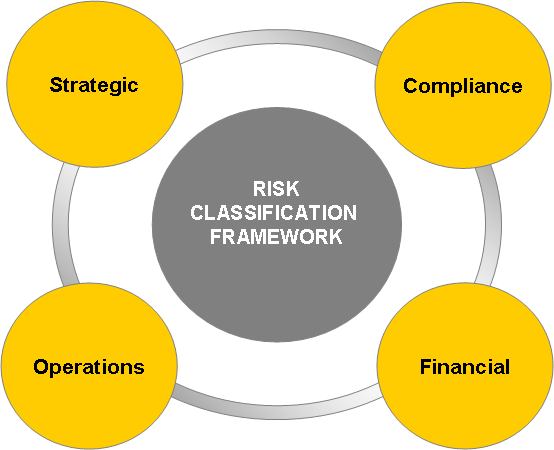
Annexure 1.1: Risk Category Definitions
I. STRATEGIC
The Company’s strategy is a systematic plan that connects the current state of a Company to its desired future state. The direction of a Company is defined by its vision and goals while strategy is the path envisaged for the achievement of those objectives. The strategy of a Company is driven by the stakeholder expectations or movements, industry outlook, market dynamics as well as the way a Company is governed and guided. Strategic risks may arise from the decisions and actions a Company takes to achieve its desired future state.
II. OPERATIONS It refers to the activities of the Company in harnessing its resources to execute its business model. This category of risks includes risks related to resources and processes which come together to create products and services that satisfy customers and help achieve the Company's quality, cost, and time performance objectives.
III. COMPLIANCE
The operations of the Company are governed by numerous laws and regulations in addition to being subject to many obligations emanating from contractual agreements entered by it. This category of risks includes risks which arise due to the Company’s inability to comply with the applicable laws, regulations and contractual terms and conditions.
IV. FINANCIAL
In the pursuit of its objectives a corporate raise and manages capital as well as protects its monetary resources. Financial risks include risks relating to the way a corporation raises and manages its finances, reduces uncertainty due to market movement of currency, interest rates and commodity prices and accounting and reporting of its finances. This category of risks also includes risks arising due to fraud and error and assessing the likelihood and impact of such risks.
Annexure 1.2: Illustrative Risk Universe Framework
Below is Illustrative risk universe which has broad themes which can be used by risk owners and team members involved in the process?
Strategic
| Governance | Major initiatives | Communication and investor relations | |||
|---|---|---|---|---|---|
| Board/Executive performance & tone at the top | Vision and direction | Media and investor relations | |||
| Corporate social responsibility | Planning and execution | Board, member/group, provider, and vendor communications | |||
| Control environment | Measurement and monitoring | Rating agencies | |||
| SecureXcel policies/alignment | Technology implementation and adaption | Regulators | |||
| Reputation | Business Acceptance | Internal/external communications | |||
| Planning and resource allocation | Identifying opportunities & leverage M&A | Management reporting | |||
| SecureXcel structure | Corporate strategy | Public perception | |||
| Growth and Strategy | Business/ product diversification | Social media strategy | |||
| Forecasting and budgeting | Research and Development | Crisis communications | |||
| Change management | Competitiveness | ||||
| Special purpose entities | Develop and market new products | ||||
| Resource capacity and allocation | Market dynamics | ||||
| Outsourcing arrangements | Macroeconomic factors e.g., recession | ||||
| Operations planning | Geopolitical factors, social unrest, or political instability | ||||
| Third-party relationships | Competition and disruption | ||||
| Asset portfolio strategy and optimization risk | Alliances/partnerships | ||||
| Sales cycle and subscription renewal | Pricing volatility | ||||
| Mergers, acquisitions, and divestiture | Customer expectations and preferences | ||||
| Opportunity identification, valuation, and pricing | Legislation | ||||
| Due diligence | Economic returns | ||||
| Planning, execution, and integration | Globalization and brand dilution | ||||
| Operations | |||||
| People and human resources | Third-party and managed services | Sales and marketing | |||
| Culture | Contract life cycle | Business Development and Promotion | |||
| Recruiting, succession planning & retention | Contract compliance — delivery | CRM (Customer Relationship Management) and support | |||
| Career development planning | Contract compliance — vendor reliability | Market research analysis and reporting | |||
| Succession planning | Third-party quality | Sales and marketing execution | |||
| Compensation and benefits | Ethical sourcing | Sales and pricing | |||
| Labour relations | IT | Social awareness | |||
| Accountability | Policy and governance | Customer trends | |||
| Leadership | Access management | Competition | |||
| Skills and competencies | Detection and monitoring | Customer experience and support | |||
| Expatriate management | Change management | Brand reputation | |||
| Ageing workforce | Data and processing integrity | Maintenance | |||
| Mobility | Threat and vulnerability management | Physical assets | |||
| Work and life trends | Program management. Application development | Optimization, maintenance, and performance | |||
| Employee safety | Product license management | Inventory | |||
| Third-party and public safety | Data governance/data integrity and security | Insurance | |||
| Talent | Infrastructure/Architecture | Product Development & Design | |||
| Performance incentives and metrics | IT reliability and recovery | Embed security | |||
| Hazards | IT security and privacy | Testing | |||
| Business interruption | Copyright / intellectual property management | Supply Chain | |||
| Uncontrollable and controllable catastrophic loss | IT Strategy | Project life cycle | |||
| Crisis management | IT supply chain management | Project management Equipment sourcing | |||
| Operational hazards | Cloud computing | Single-source dependence | |||
| Environmental hazards/ pandemic | Digital and mobile | After-sales support and customer support | |||
| Physical security | Technological change & digitization | Cost control | |||
| Cybersecurity, Software asset management | Geotechnical risk |
| Finance | Compliance | |
|---|---|---|
| Capital structure | Liquidity and Credit | Code of conduct |
| Capital management | Cash management | Ethics |
| Debt | Financing | Internal fraud, waste, and abuse |
| Equity awards/stock options | Funding | Compliance |
| Pension funds | Hedging | Appeals and grievances |
| Working capital | Credit and collections | Conflict of interest |
| Tax | Insurance | Corruption |
| Indirect taxes | Counterparty defaults | Harassment |
| Tax department operations | Accounting and Reporting | Social media |
| Transfer pricing | Financial reporting and disclosure | Legal |
| Tax technology and knowledge management | Internal control requirements | Contract |
| Property taxes | Accounting | Malpractice liability |
| IP migration/management | Delegation of Authority | Intellectual property, trademarks & patent |
| Tax-exempt status | Valuation and impairment | Litigation |
| Tax optimization | Management information systems Related – Party transactions | Regulatory |
| Tax strategy and planning | Revenue cycle | Health, safety, and environment |
| Market | Billing and collections | Competitive practices/antitrust |
| Derivatives | Charge captures and coding | Tax compliance |
| Foreign Exchange | Pricing and margin pressure | Health authority regulations |
| Interest Rate | Data protection and privacy | |
| Trading | Labour Laws | |
| Activist investors/ funding | Securities | |
| Changing political scenarios | ||
| Sanctions |
Annexure 1.3: Risk Definitions
The below table defines and explains the types of risks (not an exhaustive list) that can be identified during risk identification phases. There can be other risks which may be subsequently identified. In such cases, the risk Owners need to consult with the Designated team by Management or External Risk Management Consultant to derive the definition and use it for Enterprise Risk Management. Please read this section along with the Annexure 1.2 Illustrative Risk Universe Framework
| Sr. No. | Risk type | Risk Category | Definition |
|---|---|---|---|
| 1 | Credit | Financial | Risk areas associated with the failure of the party on the other side of the agreement to abide by the terms of the agreement |
| 2 | Environment | Operations | Risk areas that involve the complex physical and chemical, factors that influence the life of an individual or community in and around the Company premises |
| 3 | Finance | Financial | Risk areas associated with the planning, management and reporting of finances that cause the Company to not achieve its financial objectives |
| 4 | Health and Safety | Operations | Health and safety risk, within the context of occupational health, relates to an assessment of hazards that can lead to the harm, injury, death, or illness of a worker in a determined workplace. |
| 5 | Human Resources | Operations | The risk of the Company incurring losses due to drain or loss of personnel, deterioration of morale, inadequate development of human resources, inappropriate working schedule, inappropriate working and inequality or inequity. |
| 6 | Legal | Financial or Compliance | Legal risk is the potential for losses due to legal action or suits used against the Company |
| 7 | Market | Strategic or Financial | Risk areas associated with movement rates, currencies, and commodity prices that can simply impact the Company bottom's line |
| 8 | Operational | Operations | Risk areas associated with instances of loss resulting from inadequate or failed internal processes, people, and systems, or from the failure of infrastructure largely having to do with the performance, protection, and utilization of existing assets |
| 9 | Political | Strategic | Risk areas which are potentially due to political factors (events, trends, developments) affect businesses' vitality (stability, health/well-being). |
| 10 | Regulatory/Govt. Policies/Statutory | Compliance | Risk areas associated with Company compliance with applicable law provisions, rules, regulations, and standards/ policies recommended by the government |
| 11 | Reputational | Strategic | Negative publicity regarding a Company's business practices may cause a decline in the market share, costly litigation, or revenue reductions |
| 12 | Strategic | Strategic | Risk areas associated with the SecureXcel's strategic decisions to achieve its business objectives. |
| 13 | Technology | Operations | Risk due to technological failures which may disrupt the business such as security incidents/service outages/misuse of information technology |
| 14 | Security | Operations | A security risk is any event that could result in the compromise of SecureXcel assets |
| 15 | Investment Risk | Strategic | Risk areas associated with the investments made by SecureXcel |
| 16 | Policy and Procedure Risk | Operations | Risk areas associated with failure to comply or follow the process as per the documentation approved by management |
| 17 | IT / Cyber | Operations | Cyber risk means any risk of financial loss, disruption, or damage to the reputation of SecureXcel from some sort of failure of its information technology systems |
| 18 | Fraud | Financial | Risk areas associated with weakness in business and processes offer the scope for wrongful deception resulting in financial loss and personal gain |
Annexure 2: Risk Management Activity Calendar
Designated team to update the calendar at every start of financial year starting April and ending on subsequent year March.
Annexure 3: Risk Rating Criteria
Note – These criteria are subject to change, users need to refer to latest criteria which can be obtained from the designated team.
Impact
| Score | Criteria | Financial | Stakeholders | Reputation | Operations | Strategic | |
|---|---|---|---|---|---|---|---|
| External | Internal | ||||||
| 25 | Catastrophic | 1. >=30 % of SecureXcel’s total capital or total investments or2. Negatively impact PBT by more than 5% | Severe damage to the relationship with the contributing companies and disruption of SecureXcel's image | Turnover Rate of key executives or staff over 50%, critical impact on morale, or severe injury to an employee. | Global and regional media attention. Long-term damage to public image (e.g., less than 12 months). | Permanent shutdown of SecureXcel | Potential complete inability to execute SecureXcel’s strategic plans and objectives |
| 20 | Major | 1. 20 -30 % of SecureXcel’s total capital or total investments 2. Negatively impact PBT by 3.5 to 5% | The decline in satisfaction of the contributing companies of SecureXcel | Turnover Rate of key executives or staff between 25% and 50%, critical impact on morale, or severe injury to the employee. | Local media attention relating to corruption/ fraud. Long-term damage to public image (e.g., less than 12 months). | Temporary shutdown of SecureXcel | Potential inability to execute any critical element of SecureXcel’s strategic plans and objectives |
| 15 | Moderate | 1. 10 -20 % of SecureXcel’s total capital or total investments or2. Negatively impact PBT by 2 to 3.5% | The inability of SecureXcel to attract external parties | Turnover Rate of key executives or staff between 10% and 25%, serious impact on morale, or severe injury to the employee. | Local media attention excluding corruption/ fraud. Short-term damage to public image. (e.g., less than 12 months). | Temporary shutdown of specific activities | Potential inability to execute any two or more elements of SecureXcel’s strategic plans and objectives |
| 10 | Minor | 1. 5 -10 % of SecureXcel’s total capital or total investments or2. Negatively impact PBT by 0.5% to 2% | The decline in the external party's satisfaction by equal to or more than 30% | Non-recurring loss of key executives or staff, or negative impact on morale. | Internal dissemination of matters that impact reputation within SecureXcel | Inability to run, develop, or deploy specific existing or new activities | Potential partial inability to execute any one element of SecureXcel’s strategic plans and objectives |
| 5 | Insignificant | 1. <5% of SecureXcel’s total capital or total investments or2. Negatively impact PBT by less than 0.5% | The decline in the external party's satisfaction by less than30% | No loss of key executives or staff, no impact on morale. | N/A | Minimal impact on the ability to run, and develop, SecureXcel activities | Potential temporary inability or easily remedied inability to execute SecureXcel strategic plans and objectives |
Likelihood
| Score | Rating | Probability of the risk to occur and lead to assessed consequences | |
|---|---|---|---|
| Occurrence in future | Occurrence in the past | ||
| 25 | Almost Certain | Very High will be almost a routine feature every month within the immediate next year. | Similar instances have commonly occurred every month in the past. |
| 20 | Likely | High, may arise several times within the immediate next year. | Similar instances have occurred several times in the past year. |
| 15 | Possible | Possibly, may arise once or twice within the immediate next year. | There have been 1 or 2 similar instances in the past year. |
| 10 | Unlikely | May occur once or twice between year 2 (from now) to 5 years. | Though not routinely, there have been similar instances in the last 2 to 5 years. |
| 5 | Rare | Not likely, almost impossible to occur between year 2 (from now) to 5 years. | Similar instances have never occurred in the past. |
Management Preparedness
| Score | Management preparedness | Description |
|---|---|---|
| 25 | Requires critical improvement | Controls and/or Risk Management activities are non-existent or have major deficiencies and do not operate as intended |
| 20 | Requires significant improvement | Limited controls and/or Risk Management activities in place, high level of risk remains |
| 15 | Requires moderate improvement | Key controls and/or Risk Management activities in place, with moderate opportunities for improvement identified |
| 10 | Requires limited improvement | Controls and/or Risk Management activities properly designed and operating, with opportunities for improvement identified |
| 5 | Requires no improvement | Controls and/or Risk Management activities properly designed and operating as intended |
Velocity
| Score | Risk Velocity | Description |
|---|---|---|
| 5 | Rapid | Very rapid onset, little or no warning, instantaneous |
| 4 | Near Term | Onset occurs in a matter of weeks to 6 months |
| 3 | Short Term | Onset occurs in a matter of 6 months to 18 months (one and a half years) |
| 2 | Mid-Term | Onset occurs in a matter of 18 to 36 months (3 years) |
| 1 | Long-Term | Slow onset i.e., greater than 36 months (3 years) |
Note – These criteria are subject to change, users need to refer to latest criteria which can be obtained from the designated team.
Scorecard –Heat Map
Consequence
| Probability | Insignificant | Minor | Moderate | Very High | Extreme | ||
|---|---|---|---|---|---|---|---|
| Almost Certain | M | H | C | C | C | ||
| Likely | M | H | C | C | C | ||
| Possible | L | M | H | C | C | ||
| Unlikely | L | M | M | H | H | ||
| Rare | L | L | L | M | M | ||
| Level of Risk | Description | Inherent Risk C*P | |||||
| Critical (C) | Critical Risk, Immediate action required | Over 260 | |||||
| High (H) | High Risk, Corporate senior management attention needed to develop and possibly initiate action steps soon | 151 to 260 | |||||
| Moderate (M) | Moderate Risk, Functional head attention needed | 76 to 150 | |||||
| Low (L) | Low Risk, Manage by routine procedures | Less than 75 |
Annexure 4: Risk Action Matrix
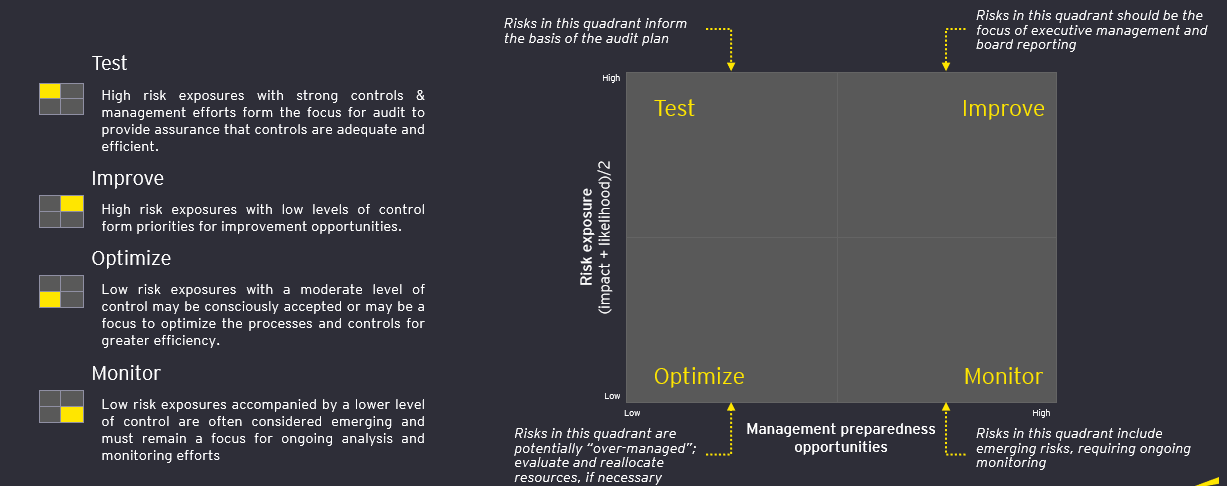
Rating table to be followed for classifying the risk for 2 X 2 action matrix.
| Category of action matrix | 2 X 2 action matrix Rating (Risk likelihood rating + Risk impact rating / 2) X Management Preparedness rating | Interpretation of the action matrix |
|---|---|---|
| Improve | Above 260 | 1. High-risk exposures with low levels of control form priorities for improvement opportunities. 2. Risks in this quadrant should be the focus of executive management and board reporting. |
| Test | 151 -260 | 1. High-risk exposures with strong controls & management efforts form the focus of the audit to assure that controls are adequate and efficient. 2. Risks in this quadrant inform the basis of the audit plan. |
| Monitor | 76-150 | 1. Low-risk exposures accompanied by a lower level of control are often considered emerging and must remain a focus for ongoing analysis and monitoring efforts 2. Risks in this quadrant include emerging risks, requiring ongoing monitoring |
| Optimize | 0- 75 | 1. Low-risk exposures with a moderate level of control may be consciously accepted or may be a focus to optimize the processes and controls for greater efficiency. 2. Risks in this quadrant are potentially “over-managed;” evaluate and reallocate resources, if necessary |
Annexure 5: Risk Dashboard (example)
The following shall be details disclosed at various level as per table.
Disclosure layers
| 1 | Disclosure | Top Sheet Power point presentation containing the following. 1. Risk event and Risk description. 2. Quantify the risk in terms of i. Risk Exposure (Value at Risk) a) Current and b) proposed ii. Actual impact 3. The Key Risk Indicators along with comparable data points related to current period and previous period and the movement of the indicator (favorable or unfavorable) 4. Mitigation plans (key steps and its status). | Detailed Slides 1. Detailed Risk descriptions which include but not limited to origins, potential impacts, and contributing factors, impact assessment and likelihood factors, triggers & events that may signal the onset or escalation of the risk. 2. Detailed mitigation plan which includes not limited to Mitigation Objectives, Key Steps/milestones, status, timelines, owner, resources. 3. Calculation of Risk exposure 4. Any supplementary information which is required for discussions | On-going risk management monitoring The risk owners need to provide details to in the risk library for each risk as per the below table and assign the HOD to review the risk in Jeera ticketing portal. Category | Field | Field Risk Event | Risk Type | Risk Event Risk Active / Inactive | Risk Description Risk Classification | Risk Impact Assessment Risk Number | RTM or Functional risk Department | Risk Owners Risk Heading | HOD Inherent Risk (Gross Risk) | Likelihood | Impact rating Likelihood Rating | Inherent Risk Impact | Level of Risk Existing Controls Measures | Treatment Type | Effectiveness Rating Existing Control measures | Effectiveness Category Existence Residual Risk rating (Net risk) | Risk Likelihood | Residual Risk Risk likelihood rating | Level of Risk Risk impact | Residual risk class Risk impact rating Risk Action Matrix | Velocity | Velocity rating Management Preparedness | NextGen action rating Management Preparedness rating | NextGen action class Risk Treatment Plans | Treatment Type | Effectiveness Rating Risk Mitigation Plan | Effectiveness Category Existence Risk Exposure | Risk Drivers | Proposed risk exposure Tolerable risk exposure | Current risk exposure | |
|---|---|---|---|---|---|
| 2 | Intended Users | Risk Committee of Board & IRC | IRC and Risk Committee of Board (as necessary) | HODs & IRC | |
| 3 | Preparer | Risk owner and HODs | Risk owner and HODs | Risk owner and HODs |
Annexure 6: Key Components of Risk Register
Below are illustrative components of Risk Register, components can be added as per the requirements of SecureXcel.
Illustrative component of Risk Register
| Risk Type | Risk likelihood rating | |
|---|---|---|
| Risk Classification | Risk Impact | |
| Risk Number | Risk impact rating | |
| Department | Inherent Risk (Impact * Probability) | |
| Risk Heading | Level of Risk (Traditional Heat Map) | |
| Risk Event | Management Preparedness | |
| Risk Description | Management Preparedness rating | |
| RTM or Functional Risk | Velocity | |
| Risk owners | Velocity rating | |
| Department Head | NextGen action rating | |
| KRIs | NextGen action class | |
| Mitigation Control Effectiveness Rating | ||
| Gross Risk Likelihood | Mitigations Plans |
Key Definitions
| Term | Definition |
|---|---|
| Function | Name of the process or function being considered |
| Major Process | List the name of the major sub-process |
| Risk # | Each risk requires a unique identifier within a Risk Register. Risk number consists of risk initials and a sequence of numbers. |
| Risk Description | Primary business risks linked to a process. Record the description of the risks relating to the Process Flow as described and defined during the preparation of the flowchart and process narratives. |
| Risk That Matters (RTM) | Refers to significant risks that have a notable impact on SecureXcel’s objectives and require focused attention in Risk Management efforts by the Management and Board of Directors/Committee thereof |
Annexure 7: Mitigation Control Effectiveness Rating
| Effectiveness Rating | Effectiveness Category | Description |
|---|---|---|
| 11-15 | Ineffective | Mitigation plans are not in place, or if in place, they do not ensure any control over the risk occurrence and impact. |
| 6-10 | Effective | Mitigation plans involve duly laying down the approval and reporting norms though not ensuring complete control over the risk occurrence and impact. |
| 0-5 | Very Effective | Mitigation plans involve stringent approval and reporting norms with responsibility for execution duly mapped to various management levels ensuring complete control over the risk occurrence. |
Annexure 8: Residual Risk Class and Required Action Matrix
| Residual risk class (Risk impact x Risk likelihood = Risk Rating) | Mitigating controls rating | Residual risk class | Required action | |
|---|---|---|---|---|
| Critical | Ineffective | = | Active Management | Require immediate treatment and response with periodic progressive reports to the CFO |
| High | Ineffective | = | Control Critical | Require active management and reporting |
| Moderate | Ineffective | = | Periodic monitoring | Requires an appropriate treatment and response and progress reporting to Designated team by Management or External Risk Management Consultant |
| Low | Very Effective | = | No Major Concern | Monitor and manage as required at the management of the Department |
Annexure 9: Request for Amendment Form
Request for Amendment Form
Name of the department or function requesting amendments: __________________________________________
Manual for: ____________________________________________________________
Section/s Reference: ____________________________________________________________
Policy Code: ____________________________________________________________
Policy Name: _____________________________________________________________
Description of needed amendments:
____________________________________________________________
Proposed amendments (solution):
____________________________________________________________
Proposed by: _______________________________________________________________
Reviewed by: _______________________________________________________________
Reviewed by: _______________________________________________________________
Approved by: _______________________________________________________________
Implementation Date: ________________________
Annexure 10: Key Components of KRI Dashboard
| Component of KRI Dashboard |
|---|
| Risk Number |
| Risk Classification |
| Department |
| Parameter |
| Key risk indicator |
| Measurement Metric |
| Monitoring Frequency |
| Current Values |
| Risk Appetite Threshold -Comfortable Zone |
| Risk Capacity Threshold - Warning Zone |
| Beyond Risk Capacity - Critical Zone |
| Actual Data |
Annexure 11: Exception Approval Reporting Template
Exception Approval to ERM Policy and Procedure
| Reference to procedure section number | ||||
|---|---|---|---|---|
| Period for which exception is sought | ||||
| Details of exception | Reason for exception | Risk perceived due to exception | Risk Mitigation and monitoring plan | |
| Preparer | Reviewer | Approval | Additional commentary section | |
| Date | Date | Date |
Annexure 12: Risk Incident Reporting
For any risks that convert into actual events, the risk owners should report the risk to the Management, or the Risk Management Committee in the Risk Incident Reporting Template as defined. The following fields shall be included in the Risk Incident Reporting
| Field | Description |
|---|---|
| Incident ID | A unique identifier for the incident. |
| Date and Time | The date and time when the incident occurred. |
| Location | The physical or digital location where the incident took place. |
| Risk ID | Mention the risk ID as per the Risk Register (if applicable) |
| Risk Description | A detailed description of the incident, including what happened and any contributing factors. |
| Risk Category | The specific risk category or domain to which the incident relates (e.g., operational, financial, legal). |
| Actual Impact | The impact of the incident on the SecureXcel or individuals involved. |
| Reoccurring Likelihood | The likelihood of the incident occurring |
| Risk Rating | The overall risk rating is calculated by multiplying the impact and likelihood. |
| Root Cause | The underlying cause or causes that led to the incident. |
| Control Effectiveness | The effectiveness of existing controls in preventing or mitigating the incident. |
| Actions Taken | Immediate actions are taken to address the incident and prevent recurrence. |
| Responsible team | The individual or team responsible for addressing the incident and implementing remedial measures. |
| Comments | The responsible team can mention any commentary or remarks |
| Recommendations | Any recommendations or suggestions for strengthening controls and preventing future incidents should be mentioned |
| Lessons Learned | Key lessons learned from the incident that can be applied to future Risk Management strategies. |
| Follow-up Actions | Any follow-up actions or tasks that need to be completed because of the incident. |
| Status | The status of the incident, such as open, resolved, or under investigation |
| Reviewer | The person or team responsible for reviewing and validating the incident report |
| Review Date | The date when the incident report was reviewed |
| Review Outcome | The outcome or decision reached during the review process |
| Approver | The person or team responsible for approving the incident report |
| Approver date | The date when the incident report was approved |
Annexure 13: Risk Appetite Metrics and Indicators or Statements
| s | Proposed Risk Appetite Statement | Business Plan 2025 | Risk Appetite Thresholds | ||
|---|---|---|---|---|---|
| Comfortable | Warning | Critical | |||
| Strategic Risk | Return on Equity (Return to Shareholders Equity) | >=4% | 2% -3.9% | <=2% | |
| Profit Margin | >=15% | 7% - 14% | <=7% | ||
| Yield on Investment (Return on Investment) | >=3% | 1%- 3% | <=1% | ||
| Credit Risk | Bank Deposit Rating (weighted average) | >=A | BB-BBB | >=BB% | |
| Bank Guarantees Executed rate | <=2% | 2.1% - 3% | >=3% | ||
| Deposits in Banks above concentration limit (No. of banks with >40% of total deposit) | 0 | 1 | 2 | ||
| Market Risk | Impaired Investments -to-Total Investments | <=5% | 6% - 19% | >=20% | |
| GCC investment Assets-to-Total Invested Assets | >=45% | 31% - 45% | >=30% | ||
| International investments to total investments | <=30% | 31% - 60% | >=60% | ||
| Currency | Foreign currency concentration (No of currencies with >30% of currency concentration) | 0 | 1 | 2 | |
| Impact of FX fluctuation on profitability | <=2% | 2% - 4.9% | >=5% | ||
| Liquidity Risk | Liquidity Coverage ratio | >=100% | 71 – 100% | <=70% | |
| Outstanding Receivables >180 Days / Total Receivables | <=20% | 21% - 24% | >=25% | ||
| Operational Risk | No of operational loss events** | <2 | 2-5 | >=5 | |
| No of instances of delay in completing G2G projects** | 0 | 1 | >=2 | ||
| IT Risk | IT Risk Score | >=80% | 31% - 79% | <=30% | |
| Reputational Risk | Reputational Risk Score | >=80% | 31% - 79% | <=30% | |
| Human Resource Risk | Human Resource Risk Score | >=80% | 31% - 79% | <=30% | |
| Audit and Compliance Risk | Compliance Risk Score | >=80% | 31% - 79% | <=30% |