Document control
Document ID: B-004
Author(s): GRC & Compliance Team
Version: 1.0
Date: 09-Nov-2026
Disclaimer:
This controlled document is intended for authorized SecureXcel use. It may not be reproduced, distributed, quoted, or disclosed outside its approved audience without prior authorization from the document owner.
Document Details
| Document Title | AI System Resources Management Procedure | ||||
|---|---|---|---|---|---|
| Document Id | SecureXcel/AIMS/B-004 | Current Version | 1.0 | Date of Release | 09-Nov-2026 |
| Classification | Internal | Author | GRC & Compliance Team | ||
| Reviewed by | GRC & Compliance Lead | ||||
| Approved by | Management Representative | AI Governance Committee (AIGC) | |||
| Designation |
Revision History
| Version | Date | Author | GRC & Compliance Team | GRC & Compliance Lead | Management Representative |
|---|---|---|---|---|---|
| 1.0 | 22/07/2025 | GRC Lead | GRC Head | AIGC | Initial version |
| 1.1 | 20/07/2026 | GRC Lead | GRC Head | AIGC | Reviewed |
1. INTRODUCTION
1.1 Purpose (B.3.1 Objective)
The core purpose of this procedure is to establish clear accountability within the organization to uphold its responsible approach for the implementation, operation, and management of AI systems. This is achieved by:
- 1. Defining and allocating specific AI-related roles and responsibilities (Control A.3.2).
- 2. Establishing a robust, confidential mechanism for reporting concerns about any AI system throughout its life cycle (Control A.3.3).
1.2 Scope
This procedure applies comprehensively to:
The entire organizational structure responsible for developing, providing, procuring, or using AI systems within the defined scope of the AIMS.
- 1. All employees, contractors, and other vendors working under the organization’s control (including suppliers and partners where contractually applicable).
- 2. All stages of the AI System Life Cycle (from conception and design through decommissioning).
1.3 Objectives
The primary objectives are to ensure:
- 1. Accountability (B.3.1): Roles and responsibilities are defined and allocated to ensure accountability for all relevant areas (e.g., risk management, human oversight, data quality).
- 2. Statutory Compliance (5.3): Board assigns and communicates the responsibility for AIMS conformance and performance reporting.
- 3. Risk Mitigation: The roles defined are adequately resourced with the necessary competence (7.2) to mitigate identified AI risks.
- 4. Effective Reporting (A.3.3): A confidential and accessible process exists to escalate concerns, ensuring effective protection from reprisals (B.3.3 f).
2. ROLES, RESPONSIBILITIES, AND AUTHORITIES
| Role | Responsibility and Authority | Reference Control |
|---|---|---|
| AIGC Committee | Authority: Reviews and validates the strategic allocation of AI System Owner roles, especially for high-risk systems. Responsibility: Oversees the effectiveness of the Concern Reporting process (B.3.3 e). | 5.3, A.3.3 |
| GRC Head | Responsibility: Leads the Role Definition Phase (5.1-5.3). Ensures roles address all relevant areas (B.3.2). Oversees the Concern Reporting Process and escalates major concerns to the AIGC. | A.3.2, A.3.3 |
| Head of Human Resources (HR) | Responsibility: Manages the communication and training of all roles (7.2, 7.3). Oversees the investigation of concerns related to personnel (e.g., harassment, competence issues). Mandatory role in reprisal prevention (B.3.3 f). | B.3.3 f |
| AI System Owner | Responsibility: Accountable for the performance, risks, and impacts of their assigned AI system (B.3.2). Ensures their system conforms to AIMS controls throughout its life cycle. | A.3.2 |
| AI CoE Lead | Authority: Initiates formal investigations into reported concerns. Responsibility: Manages the logging, confidentiality, investigation, and reporting of all concerns (B.3.3 a, g). | A.3.3 |
3. PROCEDURE FOR DEFINING AI ROLES AND RESPONSIBILITIES
This phase ensures that organizational accountability is clearly defined and allocated according to the risks posed by AI systems (B.3.2).
3.1 Identify Necessary AI Function Areas
The AI Policy Owner shall conduct a foundational analysis to identify all necessary function areas that require defined roles and responsibilities. This step ensures that all relevant areas from B.3.2 are covered:
- 1. Governance & Oversight: Risk Management, AI System Impact Assessments (A.5), Security, Safety, Privacy.
- 2. Technical Life Cycle: Development, Testing/Verification, Deployment, Performance Monitoring (A.6.2.6), Data Quality Management (A.7).
- 3. Operational: Human Oversight (B.9.3), Supplier/Customer Relationships (A.10).
- 4. Compliance: Legal conformance, Concern Reporting (A.3.3).
3.2 Define AI Roles and Allocate Responsibilities (Control A.3.2)
Based on the function areas (5.1), the AI Policy Owner shall define the specific roles and responsibilities.
- 1. Draft Role Definitions: Draft detailed responsibilities for key roles, such as AI System Owner, Data Scientist, AI Auditor, AI Ethics Reviewer, and Ethics & Concerns Officer.
- 2. RACI Allocation: Utilize the RACI (Responsible, Accountable, Consulted, Informed) framework (Appendix A) to map responsibilities for critical AI processes (e.g., AI Risk Assessment, Impact Assessment, Model Deployment). The 'Accountable' designation shall ensure accountability is assigned to the appropriate level (B.3.2).
- 3. Responsibility Granularity: Ensure responsibilities are defined at the level appropriate for the individuals to perform their duties (B.3.2). For example, the AI System Owner is Accountable for safety, but the AI Tester is Responsible for verifying safety requirements.
3.3 Formal Approval and Communication (Clause 5.3)
- 1. Internal Review: The draft Roles Matrix (Appendix A) and associated job descriptions shall be reviewed and approved by the AI Policy Owner and HR to ensure they align with existing organizational structure and labor laws.
- 2. Strategic Validation: The matrix for High-Risk AI Systems shall be validated by the AIGC Committee to ensure the accountability structure is sufficient for the risk exposure.
- 3. Board Approval: The final Roles Matrix and definitions are submitted to Board for final approval as mandated by Clause 5.3.
- 4. Communication: All defined roles and responsibilities shall be formally communicated within the organization, including through updated job descriptions, training sessions, and the internal AIMS documentation portal (5.3).
4. PROCEDURE FOR REPORTING AND RESOLVING CONCERNS
This phase ensures a formal and effective process for reporting concerns about AI systems throughout their life cycle, maintaining confidentiality and integrity (Control A.3.3).
4.1 Establish Reporting Mechanism (Control A.3.3)
The Ethics & Concerns Officer (B.3.3 c) shall ensure the following reporting mechanisms are established and promoted to all employees and contractors (B.3.3 b):
- 1. Confidential Line: A dedicated phone line or secure online form managed by the Ethics & Concerns Office, offering options for confidentiality or anonymity, or both (B.3.3 a).
- 2. Direct Channels: Direct reporting options to line management, the AI Policy Owner, the AI System Owner, or HR for non-anonymous concerns.
- 3. Accessibility: The mechanism shall be easily available and proactively promoted to all relevant personnel, including clear communication of protection from reprisals (B.3.3 f).
4.2 Receiving, Logging, and Triage
- 1. Receipt and Logging: The Ethics & Concerns Officer (B.3.3 c) receives the concern, immediately logs it in the Concern Investigation Log (Appendix C), and assigns a unique ID.
- 2. Confidentiality Preservation: The officer ensures that all identifying details (if provided) are handled strictly according to the confidentiality protocol established by the HR department (B.3.3 g, respecting B.3.3 a).
- 3. Triage and Classification: The officer classifies the concern based on severity and potential impact (e.g., Minor, Significant, Critical) and determines the appropriate investigation team.
- 4. Acknowledgment: The reporter (if not anonymous) receives an acknowledgment of receipt within a documented time frame (e.g., 48 hours).
4.3 Investigation and Resolution (B.3.3 c, d)
The Ethics & Concerns Officer shall lead or delegate the investigation, ensuring it is staffed with qualified personnel (B.3.3 c) and follows these steps:
- 1. Initial Assessment: Determine the scope, collect necessary audit evidence (event logs, design documents, data provenance records), and identify affected parties (A.3.3).
- 2. Fact Finding: Conduct interviews and analysis. If the concern relates to personnel or reprisal, the Head of HR shall be involved.
- 3. Determination: Conclude whether the concern is substantiated and identify the root cause (e.g., policy failure, human error, competence gap).
- 4. Resolution: Define corrective and preventative actions (10.2). If the resolution requires a change to the AI system (e.g., model retraining), the AI System Owner is responsible for implementation.
4.4 Escalation and Management Reporting (B.3.3 e, g)
- 1. Escalation Thresholds: The organization shall define specific thresholds for when a concern shall be escalated to the AIGC Committee and/or Board (B.3.3 e). Thresholds can include:
- Concerns classified as Critical Severity.
- Concerns involving confirmed legal nonconformity.
- Concerns involving confirmed reprisal against a reporter.
- 2. Reporting: The Ethics & Concerns Officer provides aggregate reports on concerns (while maintaining confidentiality) to the AIMS Manager for inclusion in the Management Review Inputs (9.3) and provides reports to relevant managers and the AIGC Committee (B.3.3 g).
4.5 Protection from Reprisals (B.3.3 f)
This is a critical control. The organization shall provide for effective protection from reprisals for both the persons concerned with reporting and investigation (B.3.3 f).
- 1. HR Protocol: HR establishes a zero-tolerance policy against reprisal.
- 2. Reporter Protection: HR ensures that reporters (anonymous or not) are protected from detrimental actions.
- 3. Disciplinary Action: Any confirmed case of reprisal will result in immediate disciplinary action up to and including termination, managed by the HR department.
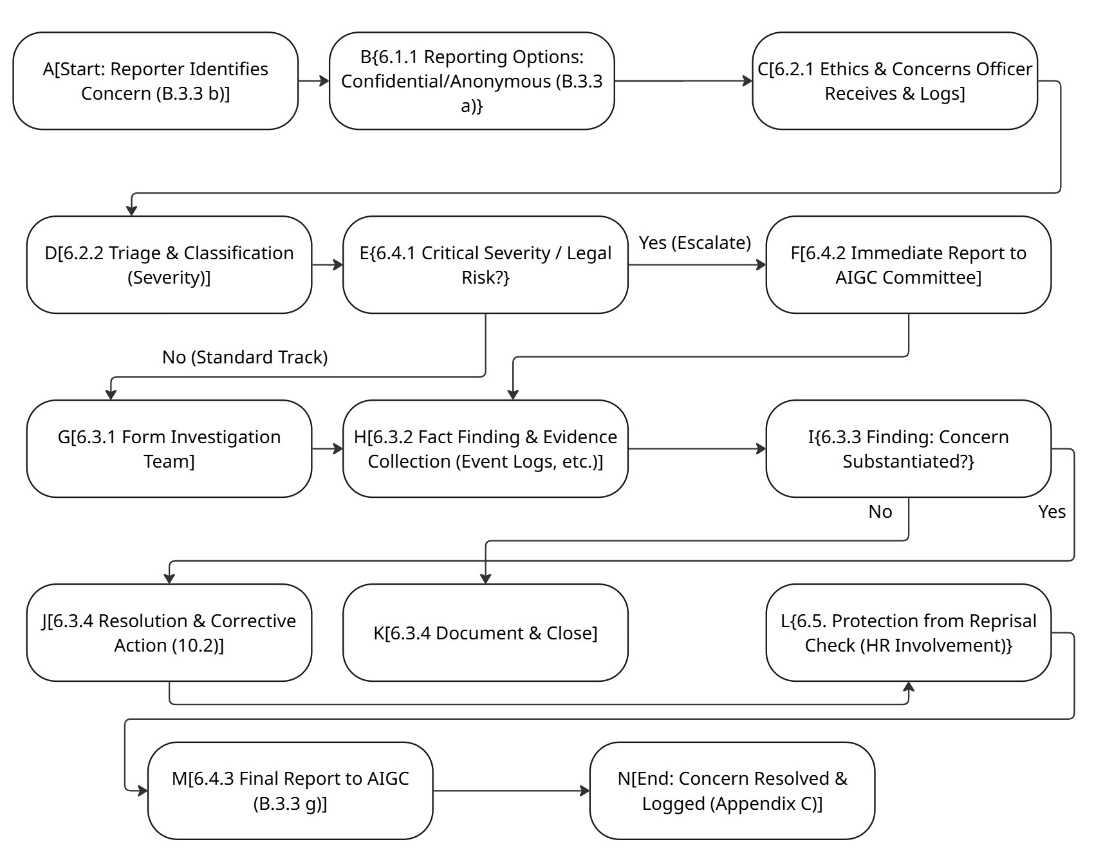
5. PROCESS MAP: CONCERN REPORTING AND RESOLUTION
This flowchart details the steps required for receiving, investigating, and escalating concerns (Section 6).
APPENDIX A: AI ROLES AND RESPONSIBILITIES MATRIX (A.3.2)
This matrix maps accountability (A) for critical AI control topics and processes to ensure accountability is defined throughout the organization (B.3.2).
RACI Key: Responsible, Accountable, Consulted, Informed
| AI Control Topic/Process (B.3.2 Examples) | AI System Owner | AIGC Committee | AI Policy Owner | Data Scientist | AI Tester | Head of HR | Ethics/Concerns Officer |
|---|---|---|---|---|---|---|---|
| AIMS Conformance (5.3 a) | A | I | R | I | I | C | C |
| AI System Risk Management (6.1.2) | A | C | R | R | C | C | I |
| AI System Impact Assessment (6.1.4 / A.5) | A | C | I | R | I | C | R |
| Defining Human Oversight Requirements (B.9.3) | A | R | I | C | R | C | C |
| Data Quality Requirements (A.7.4) | C | I | I | A | R | I | I |
| Model Verification and Validation (A.6.2.4) | C | I | I | C | A | I | I |
| Performance Monitoring Criteria (A.6.2.6) | A | C | I | C | R | I | I |
| Reporting of Concerns (A.3.3) | C | R | I | I | I | C | A |
| Competence Requirements (7.2) | C | C | I | R | R | A | I |
| Supplier Due Diligence (A.10.3) | R | C | R | C | C | I | C |
APPENDIX B: CONCERN REPORTING CLASSIFICATION CRITERIA (A.3.3)
The Ethics & Concerns Officer uses these criteria during the triage process (Section 6.2) to classify severity and determine investigation staffing and escalation requirements (B.3.3 e).
B.1 Severity Classification Table
| AI Control Topic/Process (B.3.2 Examples) | AI System Owner | AIGC Committee | AI Policy Owner | Data Scientist | AI Tester | Head of HR | Ethics/Concerns Officer AIMS Conformance (5.3 a) | A | I | R | I | I | C | C AI System Risk Management (6.1.2) | A | C | R | R | C | C | I AI System Impact Assessment (6.1.4 / A.5) | A | C | I | R | I | C | R Defining Human Oversight Requirements (B.9.3) | A | R | I | C | R | C | C Data Quality Requirements (A.7.4) | C | I | I | A | R | I | I Model Verification and Validation (A.6.2.4) | C | I | I | C | A | I | I Performance Monitoring Criteria (A.6.2.6) | A | C | I | C | R | I | I Reporting of Concerns (A.3.3) | C | R | I | I | I | C | A Competence Requirements (7.2) | C | C | I | R | R | A | I Supplier Due Diligence (A.10.3) | R | C | R | C | C | I | C |
|---|
B.2 Specific Concern Categories
Concerns shall be categorized to enable accurate reporting and trend analysis (B.3.3 g).
| Category | Definition/Scope | Role Primarily Responsible for Resolution C1. Trustworthiness/Bias | Reports of biased outcomes, lack of transparency, or issues with model explainability (C.2.11). | AI System Owner (Technical team). C2. Safety/Robustness | Reports of physical harm potential, system fragility, or unacceptable failure rates in operation (C.2.9, C.2.8). | AI System Owner (Operational/Safety team). C3. Compliance/Legal | Reports alleging a violation of a specific law, regulation, or contractual requirement (5.2 c). | Head of Legal & Compliance. C4. Governance/Policy | Reports alleging a failure in the AIMS process itself (e.g., AIMS control not implemented, role conflict, policy ignored). | AI Policy Owner (AIMS Manager). C5. Personnel/Reprisal | Reports involving alleged misconduct, incompetence, or threats/actions against a reporter (B.3.3 f). | Head of HR. |
|---|
APPENDIX C: CONCERN INVESTIGATION LOG TEMPLATE (A.3.3, 7.5)
This template serves as the documented evidence of results achieved (7.5.1 b) for the Concern Reporting Process. All entries shall be logged and maintained by the Ethics & Concerns Officer (B.3.3 g).
| Field | Detail | Example/Notes |
|---|---|---|
| Log ID | Unique Identifier | CONCERN-2025-001 |
| Date Reported | Date and Time of Receipt | 2025-09-15 10:30 UTC |
| AI System ID | Identifier for the system affected (e.g., ML-CreditScore-V3). | A.6.2.2 documentation link. |
| Reporting Status | Anonymous, Confidential, or Identified. | Confidential (Managed under HR Protocol). |
| Initial Triage | Severity (Minor, Significant, Critical) and Category (C1-C5). | Critical, C2 (Safety/Robustness). |
| Detailed Concern Summary | Brief narrative of the issue reported. | Model in autonomous manufacturing unit fails to detect metal fatigue of the time. |
| Escalation Triggered? | Yes/No. If Yes, to whom (AIGC, Board). | Yes, AIGC Notified on 2025-09-15. |
| Investigation Team Lead | Ethics Officer or other delegated lead. | Ethics Officer, Person A. |
| Root Cause Analysis (RCA) | Non-fulfilment of requirement (3.16) and cause(s) (3.17). | Cause: Test data (A.6.2.4) did not contain sufficient examples of metal fatigue in humid environments. |
| Corrective Action(s) Taken | Immediate control and correction (10.2 a). | System V3 was immediately rolled back to V2; all outputs are subject to human inspection for 72 hours. |
| Preventative Action(s) Defined | Action to eliminate cause(s) and prevent recurrence (10.2 b). | Action: Update Data Quality Requirements (A.7.4) to mandate diverse environmental test sets; retrain model V4 (6.1.3). |
| Resolution Status | Open/Closed. | Closed (2025-10-10). |
| HR/Reprisal Review | Status of HR review for potential reprisal. | Complete: No reprisal identified (B.3.3 f). |
APPENDIX D: PROCEDURE EFFECTIVENESS METRICS (9.1)
The AIMS Manager shall monitor the following Engineering LeadIs, related to B.3 control objectives, and report them during the Management Review (9.3) to assess the effectiveness of this procedure.
| Metric | Target | Measurement Frequency | Purpose (B.3 Objective) |
|---|---|---|---|
| 1. Role Definition Coverage | of all critical AI function areas (5.1) covered by an 'Accountable' role in the Roles Matrix (A.3.2). | Annually (Post-Review) | Measures compliance with accountability requirement (A.3.2). |
| 2. Concern Reporting Rate (Non-Zero) | Maintain a non-zero reporting rate (e.g., reports per quarter). | Quarterly | Ensures the mechanism is trusted and promoted (A.3.3, B.3.3 b). A zero rate may indicate fear of reprisal (B.3.3 f). |
| 3. Investigation Timeliness | of all Significant/Critical concerns are resolved (Closed Status) within the target timeframe (e.g., 30 business days). | Quarterly | Measures the effectiveness and staffing quality of the investigation process (B.3.3 c, d). |
| 4. Reprisal Incidence | Confirmed cases of reprisal (B.3.3 f) following the submission of a concern. | Annually (HR Report) | Measures compliance with protection from reprisal (B.3.3 f) and adherence to the zero-tolerance policy. |
| 5. Role Training Adherence | of individuals designated as 'Accountable' in the Roles Matrix have completed mandatory AIMS training (7.3). | Quarterly | Measures compliance with awareness and competence requirements (7.2, 7.3). |
6. CONTINUAL IMPROVEMENT OF THE PROCEDURE (10.1)
This procedure itself is subject to continual improvement (10.1). The AI Policy Owner shall recommend updates based on the following:
- 1. Audit Feedback: Internal or external audit observations related to the efficiency, resource consumption, or adherence to this procedure, particularly the clarity of role definitions or the efficiency of the investigation process.
- 2. Process Performance: Analysis of the Procedure Effectiveness Metrics (Section 11) where targets are consistently missed (e.g., low Reporting Rate, indicating a failure in trust or promotion).
- 3. Lessons Learned: Insights gathered from the Nonconformity and Corrective Action process (10.2), particularly relating to systemic failures traceable to ambiguous responsibilities or a failure to report a known concern.
- 4. ISO 37002 Alignment: Periodic review to ensure alignment with best practice guidelines for whistleblowing management systems.
7. REFERENCES AND DEFINITIONS
7.1 External References
- IS/ISO/IEC 42001:2023 – Information technology – Artificial Intelligence – Management System (AIMS)
- Clause 5.3 (Roles, responsibilities and authorities)
- Annex B.3 (Implementation guidance for AI controls - Internal organization)
- Control A.3.2 (AI roles and responsibilities)
- Control A.3.3 (Reporting of concerns)
- ISO 37002 (Whistleblowing management systems - Guidelines)
- Relevant Labor Laws and Organizational Codes of Conduct (for protection from reprisals)
7.2 Key Definitions
| Term | Definition in Context of this Procedure |
|---|---|
| AI System Owner | The individual or body accountable for the overall performance, risk, and compliance of a specific, defined AI system throughout its life cycle. |
| Concern | Any reported observation, event, or belief regarding a potential or actual deviation from the AI Policy, AIMS procedures, legal requirements, or ethical principles related to an AI system. |
| Accountability | The obligation of an individual or organization to explain and justify the fulfillment of a given responsibility (A.3.2). |
| Reporting Officer | The person or function (e.g., Ethics Office, HR) responsible for receiving, logging, and initiating the investigation of a reported concern (B.3.3 c). |
| Reprisal | Any detrimental action taken against an individual for reporting a concern in good faith (B.3.3 f). |