Document control
Document ID: B-005
Author(s): GRC & Compliance Team
Version: 1.0
Date: 09-Nov-2026
Disclaimer:
This controlled document is intended for authorized SecureXcel use. It may not be reproduced, distributed, quoted, or disclosed outside its approved audience without prior authorization from the document owner.
Document Details
| Document Title | AI Management Procedure | ||||
|---|---|---|---|---|---|
| Document Id | SecureXcel/AIMS/B-005 | Current Version | 1.0 | Date of Release | 09-Nov-2026 |
| Classification | Internal | Author | GRC & Compliance Team | ||
| Reviewed by | GRC & Compliance Lead | ||||
| Approved by | Management Representative | AI Governance Committee (AIGC) | |||
| Designation |
Revision History
| Version | Date | Author | GRC & Compliance Team | GRC & Compliance Lead | Management Representative |
|---|---|---|---|---|---|
| 1.0 | 2/07/2025 | GRC Lead | GRC Head | AIGC | Initial version |
| 1.1 | 03/08/2026 | GRC Lead | GRC Head | AIGC | Updated Section 1.4 |
1. INTRODUCTION
1.1 Purpose (B.2.1 Objective)
The core purpose of this procedure is to define the structured, rigorous, and auditable process by which the organization establishes, documents, aligns, communicates, and continually reviews its Artificial Intelligence (AI) Policy. This ensures the AI Policy effectively provides the necessary management direction and strategic support for all AI systems, consistent with business requirements, legal obligations, and the commitment to responsible AI as the Policy serves as the highest-level documented commitment under the AI Management System (AIMS).
1.2 Scope
This procedure applies comprehensively to:
- 1. All activities involved in the creation, maintenance, or revision of the official AI Policy document.
- 2. All departments responsible for creating, maintaining, or complying with other organizational policies that may intersect with the AI system development, deployment, or use.
- 3. The Board, the AI Governance Committee (AIGC), and the designated AI Policy Owner responsible for the authorization and maintenance of the AI Policy.
1.3 Objectives
The primary objectives are to ensure:
- 1. Mandatory Compliance: The AI Policy adheres to all mandatory requirements specified in IS/ISO/IEC 42001, Clause 5.2 (a-d).
- 2. Strategic Cohesion: The policy is demonstrably compatible with the organization's strategic direction and risk criteria (5.1).
- 3. Control Implementation: The organization effectively implements the controls related to Policies in Annex A.2 (A.2.2, A.2.3, A.2.4).
- 4. Integration (A.2.3): Clear, documented cross-referencing and integration between the AI Policy and other relevant organizational policies (e.g., Information Security, Quality, Privacy, and HR).
- 5. Effectiveness and Suitability: The policy is routinely reviewed and maintained to ensure its continuing suitability and effectiveness (A.2.4).
1.4 AIMS Process Landscape and Interaction (Clause 4.4)
In accordance with ISO/IEC 42001:2023, Clause 4.4, SecureXcel determines the processes needed for the AI Management System (AIMS), their application throughout the organization, and their sequence and interaction. This section defines that process landscape and applies to all AI systems formally included in the approved AIMS scope and AI System Inventory, consistent with the AIMS Scope Statement.
A. Defined List of AIMS Processes
The table below lists every process that makes up the AIMS, its primary clause or Annex A control reference, the accountable process owner, and the document in which the process is fully specified. This Procedure (B-005) governs Process 2 (AI Policy Establishment, Alignment, Communication & Review) specifically; it is one process within the broader AIMS process landscape defined here.
| # | AIMS Process | Primary Clause / Control | Process Owner | Governing Document |
|---|---|---|---|---|
| 1 | Context & Interested Party Determination | 4.1, 4.2 | AIGC & GRC Team | AIMS Manual (A00), Section 3 |
| 2 | AI Policy Establishment, Alignment, Communication & Review | 5.2, A.2.2–A.2.4 | AI Policy Owner (AIMS Manager) | This Procedure (B-005) |
| 3 | AI Objectives Setting & Monitoring | 6.2 | AIGC / GRC Team | AI-001 (AI Management Policy); AIMS Objectives Tracker |
| 4 | AI Risk Assessment & Treatment | 6.1.2, 6.1.3 | AI Risk Owners / GRC | AI Risk Management and Customer Relationship Procedure (B-008); AI Technology Risk Register |
| 5 | AI System Impact Assessment | 6.1.4, 8.4, A.5 | AI System Owners | AI System Impact Assessments Procedure (B-003) |
| 6 | Resource Management (Data, Tooling, System & Computing, Human) | 7.1, A.4 | GRC / Engineering / HR | AI System Resources Management Procedure (B-004); Approved Software, Tools & Open Source AI Models Register |
| 7 | Competency & Awareness | 7.2, 7.3 | L&D / GRC | AIMS Manual (A00), Section 7.2 |
| 8 | Internal & External Communication | 7.4, A.8.2–A.8.5 | GRC / Communications | AIMS Manual (A00), Section 7.3 |
| 9 | AI System Life Cycle Management | 8.1, A.6 | AI Lifecycle Owners | AI System Lifecycle Management Procedure (B-006) |
| 10 | Data Life Cycle Management | A.7 | Data Management Team | AI Data Management and Responsible Use Procedure (B-007) |
| 11 | Third-Party, Supplier & Customer Relationship Management | A.10 | Procurement / Legal | AI Risk Management and Customer Relationship Procedure (B-008) |
| 12 | AI Incident Management & Reporting (Internal Concerns and External/Regulatory) | A.3.3, A.8.3–A.8.5 | Ethics & Concerns Officer / Head of Legal & Compliance | AI Incident Management Procedure (B-002) |
| 13 | Monitoring, Measurement, Analysis & Evaluation | 9.1 | GRC / Engineering | AIMS Manual (A00), Section 9.1 |
| 14 | Internal Audit | 9.2 | Internal Audit Function | AIMS Manual (A00), Section 9.2 |
| 15 | Management Review | 9.3 | AIGC / Board | AIMS Manual (A00), Section 9.2; MRM records |
| 16 | Nonconformity, Corrective Action & Continual Improvement | 10.1, 10.2 | GRC / Process Owners | AIMS Manual (A00), Continual Improvement section |
B. Process Sequence and Interaction
Processes do not operate in isolation. The table below defines, for each process, the output or interface it produces and the downstream process(es) that consume it, establishing the sequence and interaction required by Clause 4.4(b). Several processes (notably AI System Life Cycle Management and Data Life Cycle Management) run in parallel and are tightly coupled rather than strictly sequential.
| Upstream Process | Output / Interface | Downstream Process |
|---|---|---|
| Context & Interested Party Determination | Determined external/internal issues and interested party requirements | AI Policy Establishment; AI Risk Assessment & Treatment |
| AI Policy Establishment, Alignment, Communication & Review | Approved AI Policy; Policy Alignment Matrix | AI Objectives Setting; Resource Management; AI System Life Cycle Management |
| AI Objectives Setting & Monitoring | S.M.A.R.T. objectives with owner, target, resourcing | Resource Management; Monitoring, Measurement, Analysis & Evaluation |
| AI Risk Assessment & Treatment | AI Risk Register; risk treatment plan | AI System Impact Assessment; AI System Life Cycle Management; Management Review |
| AI System Impact Assessment | Impact assessment report; SOA exclusion justification | AI Risk Assessment & Treatment (results feed back); AI System Life Cycle Management (deployment gate) |
| Resource Management (Data, Tooling, System, Human) | Resource inventories; competency records | AI System Life Cycle Management; Data Life Cycle Management; Competency & Awareness |
| Competency & Awareness | Training completion records; awareness evidence | Internal & External Communication; Internal Audit |
| AI System Life Cycle Management | Verified, deployed, monitored AI systems; event logs | Data Life Cycle Management (parallel/coupled); Monitoring, Measurement, Analysis & Evaluation |
| Data Life Cycle Management | Quality-verified, provenance-tracked data | AI System Life Cycle Management (parallel/coupled); AI Risk Assessment & Treatment |
| Third-Party, Supplier & Customer Relationship Management | Supplier due-diligence records; allocated responsibilities | Resource Management; Data Life Cycle Management; AI System Life Cycle Management |
| Monitoring, Measurement, Analysis & Evaluation | Performance/drift/bias metrics; KRI dashboard data | AI Incident Management (on threshold breach); Internal Audit; Management Review |
| AI Incident Management & Reporting | Incident records; corrective actions; external/regulatory reports | Nonconformity, Corrective Action & Continual Improvement; Internal & External Communication |
| Internal Audit | Audit findings; nonconformities; OFIs | Management Review; Nonconformity, Corrective Action & Continual Improvement |
| Management Review | Review decisions; resourcing/policy/objective changes | AI Policy Establishment (ad-hoc review trigger); AI Objectives Setting; Resource Management |
| Nonconformity, Corrective Action & Continual Improvement | Closed corrective actions; process improvement decisions | Context & Interested Party Determination; AI Policy Establishment; AI Risk Assessment & Treatment (closes the PDCA loop) |
Taken together, these interactions close a continual-improvement (Plan-Do-Check-Act) loop: Context and Risk determination inform the AI Policy and Objectives (Plan); Resource Management, Competency, AI System Life Cycle, and Data Life Cycle Management deliver AI systems responsibly (Do); Monitoring, Internal Audit, and Incident Management evaluate performance (Check); and Management Review, Nonconformity handling, and Continual Improvement feed decisions back into Context Determination, the AI Policy, and AI Objectives (Act), consistent with Clause 4.4(f) and Clause 10.1. This process landscape and interaction map is reviewed and updated at least annually, or upon material change to the AIMS scope, alongside the annual context review described in the AIMS Manual (A00), Section 3.1.
2. ROLES, RESPONSIBILITIES, AND AUTHORITIES
| Role | Responsibility and Authority | Reference Control |
|---|---|---|
| Board | Authority: Approves and formally expresses the AI Policy (5.2). Responsibility: Final assurance that the policy is compatible with the strategic direction and resource needs (5.1, 7.1). | 5.1, 5.2 |
| AIGC Committee | Authority: Provides mandatory strategic review and recommendation on the drafted policy. Responsibility: Ensures the policy aligns with the organization's defined risk appetite and core ethical principles. Mandates ad-hoc reviews based on strategic shifts. | 5.1, B.2.2, A.2.4 |
| AI Policy Owner (AIMS Manager) | Responsibility: Coordinates the entire policy lifecycle (Phases 1-4). Ensures all required inputs are gathered and that the policy content meets B.2.2 requirements. Reports review results to the AIGC and Board. Authority: Recommends the final policy document for AIGC and Board approval. | B.2.4, A.2.2 |
| Head of Legal & Compliance | Responsibility: Vets the policy draft to ensure commitment to all applicable legal, regulatory, and contractual requirements (5.2 c). Leads the Legal Review element of the Policy Alignment (5.4). | 5.2 c), A.2.2 |
| Departmental Policy Owners | Responsibility: Participates actively in the Policy Alignment Review (Phase 2) by confirming where their domain policies (e.g., HR, Security) are affected by, or apply to, AI systems (A.2.3). | A.2.3 |
| Internal Audit Function | Responsibility: Periodically audits this procedure and the adherence to the published AI Policy (9.2.1). Provides feedback on effectiveness during Phase 4 reviews. | 9.2.1 |
3. PROCEDURE FOR POLICY ESTABLISHMENT AND REVIEW
This procedure is executed in four defined sequential phases: Establishment, Alignment, Communication, and Review.
PHASE 1: AI POLICY ESTABLISHMENT (Control A.2.2)
The AI Policy Owner ensures the policy draft is informed by strategic inputs and comprehensive.
3.1 Determine Policy Foundation and Inputs
The AI Policy Owner shall formally document the inputs used to inform the policy, including:
- 1. Strategic Alignment: Review of the organization's long-term business strategy to ensure the policy supports the direction and is not contradictory.
- 2. Risk Appetite Determination: Consultation with the AIGC Committee and Risk Management to define the high-level risk appetite the organization is willing to pursue or retain regarding the deployment of novel AI technologies (B.2.2).
- 3. Legal Landscape Review: Comprehensive review by Legal/Compliance of current and pending AI-specific regulations (e.g., EU AI Act, specific national data laws).
- 4. Context and Stakeholder Impact: Documenting the organization's current roles with respect to AI systems (4.1) and documenting key needs and expectations of relevant interested parties (4.2, B.2.2).
3.2 Draft Policy Content (A.2.2)
The AI Policy Owner drafts the AI Policy, ensuring it explicitly addresses the following:
- 1. Mandatory Commitments (5.2): Incorporating the four mandatory commitments (Purpose, Objectives Framework, Applicable Requirements, and Continual Improvement).
- 2. Guiding Principles: Establishing the core ethical principles (e.g., fairness, transparency) and specifying the organization's stance on them.
- 3. Cross-References: Including necessary cross-references to other organizational policies dealing with specific topics (e.g., Data Security, Privacy, HR) (B.2.2).
- 4. Deviation Protocol: Defining, at a high level, the protocol for handling exceptions and deviations (B.2.2).
3.3 Formal Approval Cycle (A.2.2)
The policy draft undergoes a two-step approval gate to ensure both strategic and formal endorsement:
- 1. AIGC Committee Review: The draft is submitted to the AIGC Committee for strategic review to ensure alignment with the defined risk appetite, ethical posture, and strategic goals. The Committee provides a formal recommendation or requests revisions.
- 2. Board Approval: Upon receiving a favorable recommendation from the AIGC, the policy is submitted to Board for final, formal sign-off. The policy is only deemed "established" upon this documented approval.
PHASE 2: POLICY ALIGNMENT AND INTEGRATION (Control A.2.3)
This phase ensures the new AI Policy is seamlessly integrated into the organization's existing governance framework.
3.4 Conduct Policy Intersect Analysis (A.2.3)
The AI Policy Owner coordinates a formal "Alignment Workshop" involving all Departmental Policy Owners and the Legal team. The workshop determines:
- 1. Affected Domains: Identifying all existing policies that could be affected by AI systems (e.g., Quality, Security, HR hiring practices, etc.).
- 2. Applicability Check: Determining which existing policies apply to the organization's AI objectives (e.g., the existing Information Security Policy applies to AI infrastructure).
- 3. Gap Identification: Pinpointing where existing policies fail to account for unique AI risks (e.g., adversarial attacks, data bias).
3.5 Determine and Implement Actions (A.2.3)
For every identified intersection, a documented action must be taken and tracked:
- 1. Mandatory Update: If the gap exposes a critical risk (e.g., insufficient controls against data poisoning), the relevant Departmental Policy Owner must initiate an update to their policy.
- 2. Explicit Cross-Reference: The AI Policy shall explicitly reference the related policy's scope and requirements where appropriate.
- 3. Policy Alignment Matrix Sign-off: The outcomes of the analysis and the planned actions must be documented in a Policy Alignment Matrix (Appendix B), which is formally signed off by the AI Policy Owner and Legal/Compliance.
PHASE 3: POLICY COMMUNICATION AND CONTROL (Clause 7.5)
This phase ensures the policy is controlled and effectively communicated across all relevant parties.
3.5 Policy Documentation, Versioning, and Control (7.5.3)
The AI Policy Owner assigns the next sequential version number and date, and ensures the policy is stored in the central document repository.
- 1. Control Measures: Access controls (e.g., read-only access for general staff) and preservation mechanisms (legibility and integrity) are implemented to protect the documented information.
- 2. External Document Management: Documented information of external origin (e.g., regulatory guidelines referenced in the policy) is identified and controlled as appropriate (7.5.3).
3.6 Policy Communication and Awareness (5.2, 7.3)
- 1. Internal Awareness: The AI Policy Owner ensures all persons doing work under the organization’s control (including contractors) are made aware of the policy through mandatory training, which details their contribution to the effectiveness of the AIMS and the implications of nonconformity (7.3).
- 2. External Availability: The policy (or an approved summary) is made available to external interested parties, as required by legal or contractual obligations, or where deemed necessary for transparency by the AIGC Committee.
PHASE 4: POLICY REVIEW AND CONTINUAL IMPROVEMENT (Control A.2.4)
The AI Policy must be subject to periodic, comprehensive review to ensure its continuing suitability and effectiveness.
3.8 Establish Review Frequency and Authority (A.2.4)
- 1. Planned Review: The AI Policy Owner defines a planned review interval (typically annual, concurrent with the Management Review cycle).
- 2. Review Authority Chain: The AI Policy Owner coordinates the review, the AIGC Committee performs the strategic assessment, and Board provides final re-approval.
3.9 Trigger Ad-Hoc Policy Review (A.2.4)
An ad-hoc review is mandatory upon the occurrence of any significant event that impacts the policy’s foundation:
- 1. Major Governance Directive: A formal directive issued by the AIGC Committee or Board regarding a strategic change.
- 2. Unacceptable Residual Risk: The AI Risk Assessment (6.1.2) identifies an unacceptable risk level that cannot be treated by existing controls and indicates a fundamental flaw in the policy's guidance.
- 3. Systemic Nonconformity: Repeated failures resulting from the same cause, suggesting the policy is inadequate in eliminating systemic risks (10.2).
3.10 Conduct Comprehensive Policy Review (B.2.4)
The AI Policy Owner compiles all inputs (Appendix C) and submits them for strategic and formal review:
- 1. AIGC Strategic Assessment: The Committee reviews the policy's strategic fit, ensures ethical consistency, and verifies that the policy remains aligned with the organization's evolving risk appetite.
- 2. Effectiveness Evaluation: The review assesses the effectiveness of the policy by analyzing trends in nonconformities, deviations, and audit results (9.3).
3.11 Policy Update, Gap Analysis, and Re-Approval
- 1. Gap Analysis: If changes are necessary, the AI Policy Owner conducts a Gap Analysis comparing the existing policy against new external requirements and internal operational needs.
- 2. Re-Alignment: Any revisions trigger a mini-Policy Alignment Review (5.4) to ensure the changes do not create conflicts with existing departmental policies.
- 3. Re-Approval: The revised policy follows the full approval cycle (5.3) before being re-released and re-communicated (5.7).
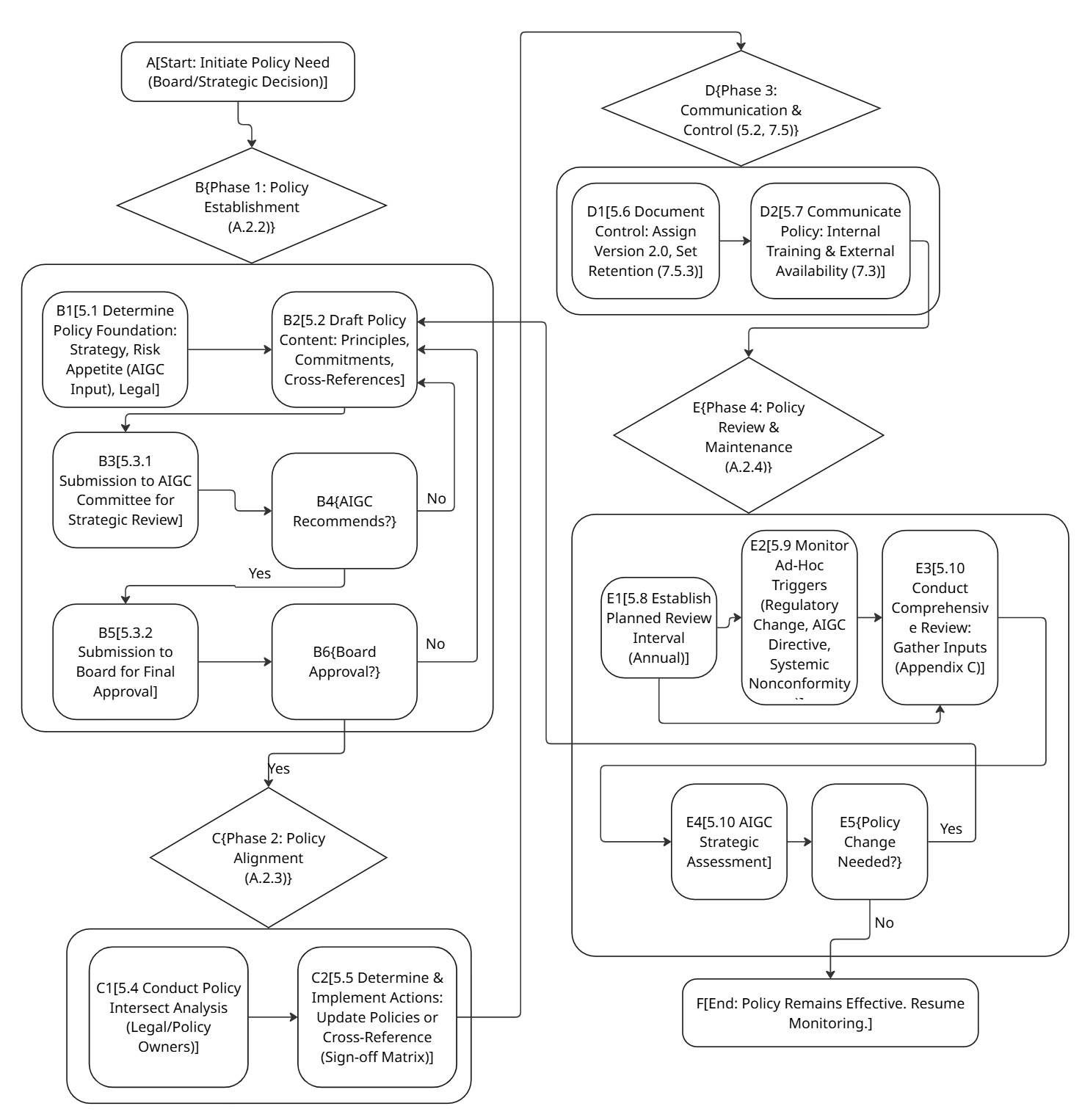
4. PROCESS MAP: AI POLICY LIFE CYCLE
This flowchart details the four phases of the AI Policy Life Cycle as described in Section 5, explicitly showing the role of the AIGC Committee.
APPENDIX A: AI POLICY CONTENT CHECKLIST (A.2.2)
This checklist provides the minimum mandatory content and recommended additions for the organization’s primary AI Policy document.
| Section | Mandatory Requirement (5.2) | Content Guidance (B.2.2 & A.2.2) | Intent/Detailed Rationale |
|---|---|---|---|
| P-1.0 Title/Owner | Must be formally designated. | Control A.2.2: Document a policy for the development or use of AI systems. | Establishes formal ownership for governance and accountability (A.3.2). |
| P-2.0 Introduction | Appropriate to the purpose of the organization (5.2 a). | Informed by Business Strategy and Organizational Values. Defines the organization's high-level Risk Appetite related to AI. | Links AI activities directly to strategic mission and sets the overall tone for ethical commitment (B.2.2). |
| P-3.0 AI Objectives | Provides a framework for setting AI objectives (5.2 b). | High-level, strategic goals (e.g., "Achieve functional reliability," "Maintain compliance with all global AI regulations"). | Provides the necessary structure for Clause 6.2 (AI Objectives) to be defined at operational levels. |
| P-4.0 Compliance | Includes a commitment to meet applicable requirements (5.2 c). | Commitment to legal, regulatory, contractual, and industry best practices. Specifies the role of Legal/Compliance. | Establishes the necessary commitment to accountability and prevents legal nonconformity. |
| P-5.0 Improvement | Includes a commitment to continual improvement of the AIMS (5.2 d). | Statement on commitment to regular reviews, nonconformity handling, and proactive adoption of new controls. | Mandates the PDCA cycle for the AIMS framework (10.1). |
| P-6.0 Core Principles | Principles that guide all AI activities. | Principles for responsible AI (e.g., Fairness, Transparency, Accountability, Privacy, Safety, and Robustness). | These principles inform the objectives (6.2) and the definition of necessary controls (6.1.3). |
| P-7.0 Topic Guidance | Topic-specific aspects to provide guidance. | Cross-references to policies on: AI Resources (A.4), AI System Impact Assessment (A.5), and AI System Development/Life Cycle (A.6). | Ensures integration and avoid duplication while covering key AI-specific risks (B.2.2). |
| P-8.0 Deviations | Processes for handling deviations and exceptions. | Defined process for requesting, approving, documenting, and monitoring deviations from policy principles (Appendix D). | Provides necessary operational flexibility without undermining the core policy commitment (B.2.2). |
APPENDIX B: POLICY ALIGNMENT MATRIX (A.2.3)
This matrix is used to document the outcome of the Policy Intersect Analysis (Section 5.4 and 5.5). The documented actions ensure that the AI Policy is not an isolated document.
| Existing Policy | Relevance to AI Systems | Intersection Identified? (Yes/No) | Action Required (5.5) | Owner |
|---|---|---|---|---|
| Information Security Policy (ISO/IEC 27001) | Applies to storage, access control, and protection of all training/production data and models. | Yes | Action: Update existing policy to include specific controls for data poisoning and model inversion attacks. Action: AI Policy to cross-reference security requirements for model deployment. | Head of Security |
| Data Privacy Policy (ISO/IEC 27701) | Governs the collection, use, and anonymization of Personally Identifiable Information (PII) used in training sets. | Yes | Action: Update existing policy to mandate Privacy-Enhancing Technologies (PETs) for PII used in ML models to minimize privacy risk. | Head of Compliance |
| Quality Management Policy (ISO 9001) | Applies to the quality and reliability of services provided via AI systems (e.g., service level agreements). | Yes | Action: AI Policy to cross-reference the Quality Management Policy regarding change control and service reliability metrics for operational AI systems (A.6.2.6). | Head of Quality |
| HR/Code of Conduct | Covers employee roles, required competencies, and ethical conduct. | Yes | Action: Update HR policy to include required competencies for AI Developers/Auditors (7.2). Action: AI Policy defines the ethical boundaries of AI use (e.g., prohibiting use for discriminatory screening). | Head of HR |
| Procurement/Supplier Policy | Governs the sourcing of third-party AI systems or components (A.10.3). | Yes | Action: Update Procurement Policy to require mandatory AI due diligence/risk assessments for all third-party AI suppliers. | Head of Procurement |
| Environmental Policy | Addresses energy consumption and sustainability (C.2.4). | Yes | Action: AI Policy to reference the Environmental Policy regarding minimum efficiency standards for AI system compute resources (B.5.5). | Head of Sustainability |
APPENDIX C: POLICY REVIEW INPUT CHECKLIST (A.2.4)
The AI Policy Owner shall utilize this detailed checklist during the policy review (Section 5.10) to ensure continuing suitability and effectiveness.
C.1 AIMS Governance and Performance Data
| Input Source | Check Requirement | Review Assessment | Action/Decision Point |
|---|---|---|---|
| Management Review Results (9.3.3) | Decisions on continual improvement opportunities and policy changes from Board. | Reviewed and incorporated. | Does Board require a new AI principle based on recent strategy shifts? |
| Nonconformity Records (10.2) | Systemic Nonconformities: Recurring failures (e.g., multiple bias incidents) where corrective actions failed. | Reviewed for systemic gaps. | Is the policy principle on 'Fairness' too vague, leading to consistent implementation failure? |
| Internal Audit Results (9.2) | Findings related to control failures, particularly in areas of policy implementation or communication. | Reviewed for policy clarity/compliance. | Does the policy language need simplification or clarification? |
| External Reports (A.8.3) | User or interested party reports of unfairness, bias, or unintended harm caused by an AI system. | Reviewed for principle failure. | Are the policy's ethical commitments being violated in practice? |
| AIGC Committee Directives | Formal strategic guidance or directives issued by the AIGC. | Reviewed and addressed. | Is the policy correctly reflecting the current organizational Risk Appetite? |
C.2 Risk and Operational Data
| Input Source | Check Requirement | Review Assessment | Action/Decision Point |
|---|---|---|---|
| Latest AI Risk Assessment (6.1.2) | Emerging Risks: Identification of new or significantly increased unacceptable risks (e.g., a new type of adversarial attack) not covered by existing policy. | Reviewed for risk exposure. | Does the policy need a new control objective to mitigate an emerging threat? |
| Latest AI System Impact Assessments (6.1.4) | Identification of new societal or individual impacts from deployed or planned AI systems, especially on vulnerable groups. | Reviewed for impact mitigation. | Does the policy's scope need to be expanded to cover a new area of social impact? |
| Deviation Handling Log (A.2.2) | Trend Analysis: Frequency and type of approved policy deviations/exceptions. | Reviewed for policy practicality. | If deviations are frequent, is the policy impractical and should be adjusted? |
| Resource Changes (7.1) | Major shifts in the availability of necessary AI resources (compute, data specialists). | Reviewed for feasibility. | If resources are constrained, does the policy need to be less ambitious? |
C.3 Contextual and External Data
| Input Source | Check Requirement | Review Assessment | Action/Decision Point |
|---|---|---|---|
| External/Internal Issues (4.1) | Changes in legal, regulatory, or technical environment (e.g., new AI governance laws, new open-source models, competitive landscape). | Reviewed for external relevance. | Is the policy legally compliant with the new regulatory landscape? |
| Interested Party Needs (4.2) | Significant changes in the needs and expectations of customers, regulators, or partners regarding AI trustworthiness. | Reviewed for stakeholder relevance. | Does the policy need to increase transparency based on new customer demands? |
| Organizational Changes (6.3) | Review of any planned changes to the AIMS (e.g., acquisition of a new business unit that uses a different AI model lifecycle). | Reviewed for integration. | Does the policy need to incorporate a new technology or domain? |
APPENDIX D: PROCEDURE FOR HANDLING AI POLICY DEVIATIONS
The AI Policy (P-8.0) requires a formal process for handling temporary exceptions. This appendix details the rigorous process to maintain control while allowing operational flexibility.
D.1 Objective
To provide a formal, documented, and risk-managed pathway for requesting, reviewing, and authorizing temporary exceptions to the established AI Policy principles or requirements, while ensuring residual risk remains within the organization's acceptable risk appetite.
D.2 Responsibility and Authority
- Requestor: Any employee or team requiring an exception.
- Deviation Review Board (DRB): A mandated multi-disciplinary team led by the AI Policy Owner, including representatives from Legal, Risk Management, and Technical Architecture. The DRB must convene physically or virtually for all High/Critical deviation requests.
- Board: Final approval authority for all deviations classified as High or Critical Risk (D.3, Step 4).
D.3 Deviation Handling Steps (D.3)
| Step | Activity | Documentation Required | Responsibility |
|---|---|---|---|
| 1. Request Submission | Requestor documents the specific policy requirement being deviated from, the justification (business, technical, or resource), and the proposed duration (max 12 months). | Deviation Request Form, including a mandatory root-cause analysis of why the policy cannot be met. | Requestor |
| 2. Risk Assessment & Classification | The Requestor conducts a focused, mini AI Risk Assessment (6.1.2) specifically on the risks introduced by the deviation. The deviation is classified (Low/Medium/High/Critical). High/Critical deviation requests must be submitted to the DRB for immediate review. | Documented risk analysis, outlining potential consequences (impacts) and associated likelihood. | Requestor / AIMS Manager |
| 3. Review and Mitigation Strategy | The DRB reviews the request, risk assessment, and legal implications. They define necessary compensating controls (e.g., manual human-in-the-loop validation, enhanced logging, immediate system rollback plan) to manage the residual risk to an acceptable level. | DRB Meeting Minutes, detailing discussion, risk acceptance justification, and required compensating controls. | Deviation Review Board (DRB) |
| 4. Approval and Authorization | Low/Medium Risk: Approved by the DRB lead (AI Policy Owner). High/Critical Risk: Requires escalation and final authorization from Board after AIGC Committee notification. | Formal Authorization Log, documenting approval level, duration of deviation, and review schedule. | Board or DRB Lead |
| 5. Monitoring and Review | The AI Policy Owner schedules mandatory periodic reviews (e.g., monthly) of the approved deviation to confirm compensating controls remain effective and to ensure the deviation is closed or resolved by the documented deadline. | Deviation Monitoring Log, including closure report and lessons learned for policy update consideration (B.2.4). | AI Policy Owner |
5. PROCEDURE EFFECTIVENESS METRICS
To ensure the effectiveness of this procedure (AIMS-PR-001) in fulfilling its objectives, the AIMS Manager shall monitor the following key performance indicators (Engineering LeadIs) and report them during the Management Review (9.3).
| Metric | Target | Measurement Frequency | Purpose |
|---|---|---|---|
| 1. Policy Timeliness | of planned policy reviews are conducted within the established interval. | Annually | Measures compliance with the mandatory review control (A.2.4) and governance discipline. |
| 2. Communication Reach | of relevant personnel complete mandatory AI Policy awareness training within 30 days of policy release/revision. | Quarterly | Measures compliance with communication and awareness requirements (5.2, 7.3). |
| 3. Alignment Score | new high-risk intersecting policies identified during ad-hoc reviews that were not included in the last planned Policy Alignment Review (A.2.3). | Ad-Hoc / Annually | Measures the thoroughness and quality of the Policy Intersect Analysis (5.4). |
| 4. Nonconformity Linkage | of all critical AI-related nonconformities can be linked back to a specific clause or principle within the AI Policy. | Quarterly | Measures the adequacy and suitability of the policy as a control mechanism. |
| 5. High-Risk Deviation Rate | of all approved deviations are classified as High or Critical Risk. | Quarterly | Indicates the degree to which operational practices adhere to policy without significant exception. |
| 6. Deviation Closure Rate | of all authorized policy deviations are closed or resolved before their scheduled expiration date. | Quarterly | Measures the effectiveness of the Deviation Handling process (Appendix D) and control of residual risk. |
6. CONTINUAL IMPROVEMENT OF THE PROCEDURE
This procedure itself is subject to continual improvement (10.1). The AI Policy Owner shall recommend updates based on the following:
- Audit Feedback: Internal or external audit observations related to the efficiency, resource consumption, or adherence to this procedure.
- Process Performance: Detailed analysis of the Procedure Effectiveness Metrics (Section 11) where targets are consistently missed (e.g., a low Alignment Score indicates this procedure's Phase 2 needs revision).
- Lessons Learned: Insights gathered from the Nonconformity and Corrective Action process (10.2), particularly relating to policy deviations that resulted in negative outcomes.
7. REFERENCES AND DEFINITIONS
7.1 External References
- IS/ISO/IEC 42001:2023 – Information technology – Artificial Intelligence – Management System (AIMS)
- Clause 5.2 (AI Policy Requirements)
- Annex A.2 (Reference Control Objectives and Controls)
- Annex B.2 (Implementation Guidance for AI Controls - Policies)
- IS/ISO/IEC 27001 (Information Security Management)
- IS/ISO/IEC 27701 (Privacy Information Management)
- ISO 31000 (Risk Management Guidelines)
7.2 Key Definitions
| Term | Definition in Context of this Procedure |
|---|---|
| AI Policy | The intentions and direction of the organization regarding the development or use of AI systems, formally expressed by Board (ISO 42001, 5.2). |
| AIMS | Artificial Intelligence Management System (ISO 42001, 4.4). |
| Board | The person or group who directs and controls the organization at the highest level (ISO 42001, 3.3). |
| AI Policy Owner | The role, typically the AIMS Manager or equivalent governance lead, responsible for the development, review, and operational evaluation of the AI Policy (B.2.4). |
| AIGC Committee | Artificial Intelligence Governance Committee responsible for reviewing and providing strategic oversight on AI-related strategy, risk appetite, and policy alignment. |
| Alignment | The process of determining and reconciling the intersection between the AI Policy and other organizational policies (A.2.3). |
| Risk Appetite | The amount and type of risk an organization is willing to pursue or retain in the pursuit of its AI objectives. |