Document control
Document ID: B-008
Author(s): GRC & Compliance Team
Version: 1.0
Date: 09-Nov-2026
Disclaimer:
This controlled document is intended for authorized SecureXcel use. It may not be reproduced, distributed, quoted, or disclosed outside its approved audience without prior authorization from the document owner.
Document Details
| Document Title | AI Risk Management and Customer Relationship Procedure | ||||
|---|---|---|---|---|---|
| Document Id | SecureXcel/AIMS/B-008 | Current Version | 1.0 | Date of Release | 09-Nov-2026 |
| Classification | Internal | Author | GRC & Compliance Team | ||
| Reviewed by | GRC & Compliance Lead | ||||
| Approved by | Management Representative | AI Governance Committee (AIGC) | |||
| Designation |
Revision History
| Version | Date | Author | GRC & Compliance Team | GRC & Compliance Lead | Management Representative |
|---|---|---|---|---|---|
| 1.0 | 22/08/2025 | GRC Lead | GRC Head | AIGC | Initial version |
| 1.0 | 03/08/2026 | GRC Lead | GRC Head | AIGC | No Changes made |
1. INTRODUCTION
1.1 Purpose (6.1.1 General, A.10.1 Objective)
The core purpose of this procedure is two-fold:
- 1. Risk Management (6.1): To establish the mandatory, systematic process for defining AI risk criteria, assessing AI risks, and determining appropriate AI risk treatment actions to prevent or reduce undesired effects and achieve continual improvement.
- 2. External Control (A.10.1): To ensure that the organization understands its responsibilities, remains accountable, and risks are appropriately apportioned and managed when third parties (suppliers, partners, customers) are involved at any stage of the AI system life cycle.
1.2 Scope
This procedure applies to:
- All AI Systems and Activities: Any development, procurement, deployment, or use of an AI system within the AIMS scope.
- Risk Evaluation: The initial and ongoing assessment of AI risks and opportunities.
- External Interfaces: All contractual and operational relationships with suppliers, third-party component providers, partners, and customers that rely on or interact with the organization's AI systems.
1.3 Objectives
The primary objectives are to ensure:
- 1. Risk Criteria Definition (6.1.1): Clear, documented criteria are established for distinguishing acceptable from non-acceptable AI risks.
- 2. Consistent Assessment (6.1.2): AI risk assessments are designed to produce consistent, valid, and comparable results, informed by context and impact.
- 3. Statement of Applicability (SoA) (6.1.3): A comprehensive SoA is produced, documenting all necessary controls and justification for inclusion or exclusion.
- 4. Accountability (A.10.2): Responsibilities across the AI system life cycle are clearly and formally allocated between internal teams and external parties.
- 5. Supplier Alignment (A.10.3): Suppliers' products and services align with the organization's approach to responsible AI.
- 6. Customer Consideration (A.10.4): Customer expectations and needs are considered, and they are provided with the necessary information to manage their own risks.
3. ROLES, RESPONSIBILITIES, AND AUTHORITIES
| Role | Responsibility and Authority | Reference Control |
|---|---|---|
| Risk Management Officer (RMO) | Accountable for the entire risk management process (6.1). Authority to establish risk criteria (6.1.1), lead risk assessment/treatment, and approve the Statement of Applicability (SoA). | 6.1.1, 6.1.3 |
| AIGC Committee | Authority for the formal acceptance of residual AI risks (6.1.3). Reviews and approves major changes to the AI Risk Criteria (6.1.1). | 6.1.3 |
| AI System Owner (ASO) | Responsible for defining the domain, intended use, and external context of the specific AI system (6.1.1). Responsible for executing the AI Risk Treatment Plan (8.3). | 6.1.2, 8.3 |
| Procurement/Supplier Manager | Responsible for establishing and documenting the vetting process for all AI suppliers (A.10.3). Ensures contractual allocation of responsibilities (A.10.2). | A.10.3, A.10.2 |
| Legal & Compliance | Responsible for identifying applicable legal requirements and contractual obligations for risk assessment (6.1.2). Vets all external party contracts for liability and responsibility apportionment. | 4.1, A.10.2 |
| External Communication Team | Responsible for determining and providing necessary information to customers/partners to manage their risks (A.10.4, A.8.5). | A.10.4 |
3. PART A: AI RISK MANAGEMENT PROCESS (6.1)
This part follows the standard risk cycle: define criteria, assess, and treat.
3.1 Define AI Risk Criteria (6.1.1)
The RMO shall establish and maintain AI Risk Criteria, which must be approved by the AIGC Committee.
3.1.1 Risk Acceptance Criteria
Criteria must be documented to support distinguishing acceptable from non-acceptable risks. This includes:
- Consequence Thresholds: Defining the severity levels (e.g., Catastrophic, Major, Moderate, Minor) for impacts on individuals, society, and the organization (e.g., financial loss, reputational damage, safety violation).
- Risk Matrix: Defining the combination of consequence and likelihood that results in an "Critical," "High," "Medium," or "Low" risk rating.
3.1.2 Risk Assessment Criteria
Criteria for performing the risk assessment, including the methodology, tools, and frequency (e.g., initial assessment at design phase, ad-hoc assessment upon major change).
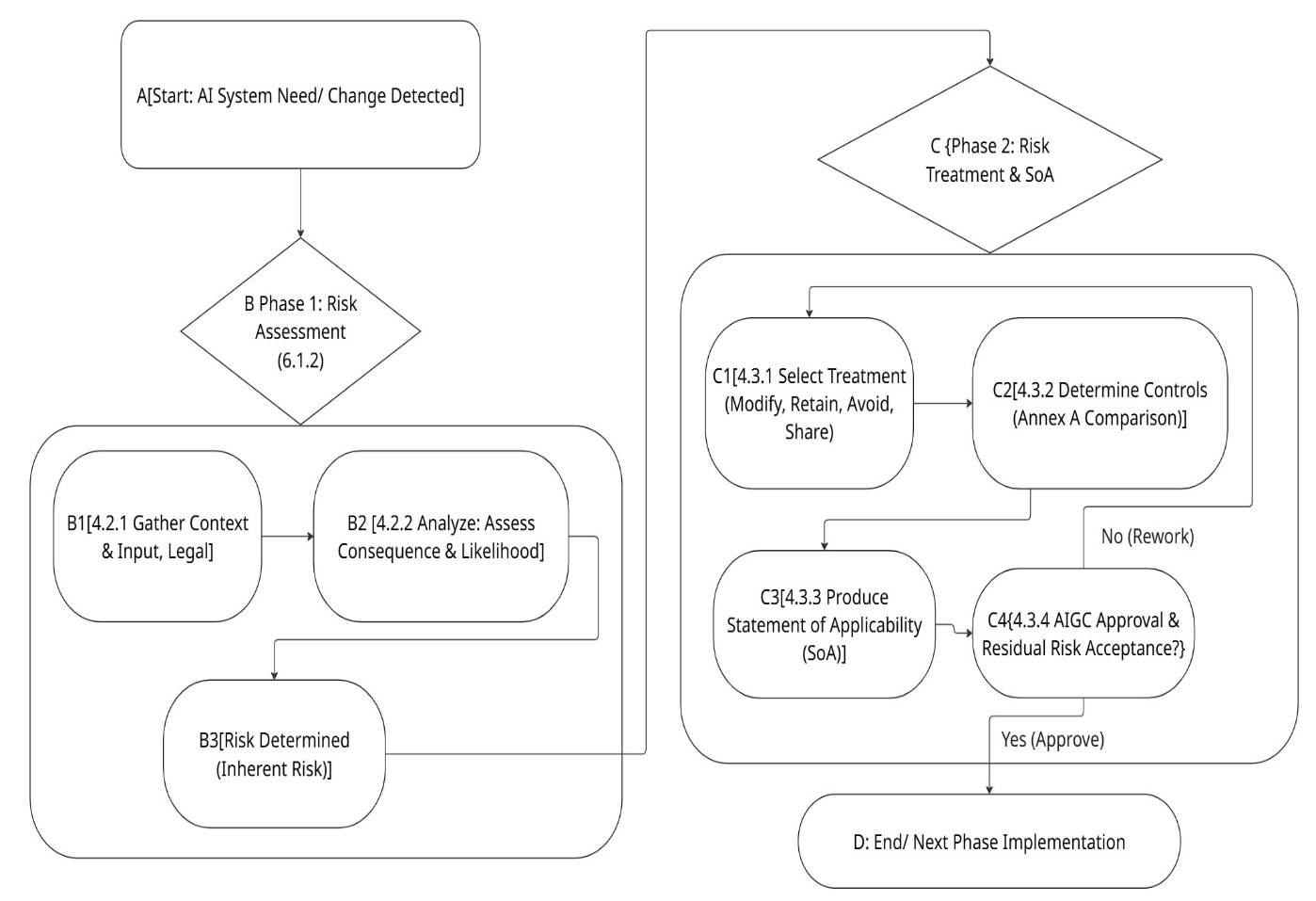
3.2 AI Risk Assessment (6.1.2, 8.2)
The AI System Owner initiates the assessment process at planned intervals (at least Annually) or when significant changes occur (8.2).
3.2.1 Context and Input Gathering (6.1.1)
The ASO documents the AI system's domain, intended use, and external/internal context (4.1). Mandatory inputs include:
- AI System Impact Assessment : The potential consequences on individuals and societies must be used to analyze consequence severity (6.1.2 d) 1)).
- Legal Requirements: Requirements from Legal & Compliance regarding prohibited uses and compliance obligations.
- Internal Organization: Roles and responsibilities that affect the ability to manage risk.
3.2.2 Risk Analysis and Evaluation (6.1.2 d, e)
The RMO analyzes identified AI risks (see Appendix B for potential sources) to produce documented results:
- 1. Consequence Assessment (6.1.2 d) 1)): Assess the potential consequences if the identified risk materializes (using the Impact Assessment as a key input).
- 2. Likelihood Assessment (6.1.2 d) 2)): Assess the realistic likelihood of occurrence.
- 3. Risk Determination (6.1.2 d) 3)): Determine the initial level of risk (inherent risk).
- 4. Prioritization (6.1.2 e) 2)): Evaluate the inherent risk against the established Risk Acceptance Criteria (4.1.1) and prioritize risks for treatment.
3.3 AI Risk Treatment and SoA (6.1.3, 8.3)
For risks deemed "High" or "CriticalCritical," the RMO defines a treatment process.
3.3.1 Select Risk Treatment Options (6.1.3 a)
Select appropriate treatment options, including:
- Modify Risk: Apply controls (e.g., mandatory human oversight, stricter V&V).
- Retain Risk: Accept the residual risk (requires AIGC approval).
- Avoid Risk: Discontinue the system or process that generates the risk.
- Share Risk: Apportion risk to an external party (e.g., supplier, insurance), formalizing via contract (A.10.2). / Transfer Risk
3.3.2 Determine Necessary Controls (6.1.3 b, c, d)
The RMO determines all controls necessary to implement the chosen treatment options:
- 1. Reference Comparison (6.1.3 b, c): Compare necessary controls against those in Annex A to verify no critical controls (e.g., A.7.4 Data Quality) have been omitted.
- 2. Additional Controls (6.1.3 d): Identify and design any additional controls necessary beyond Annex A.
3.3.3 Statement of Applicability (SoA) Production (6.1.3 f)
The RMO produces and maintains the SoA, which documents:
- The necessary controls selected (4.3.2).
- Justification for the inclusion of controls.
- Justification for the exclusion of controls (e.g., control is not necessary based on risk assessment, or is subject to an exception under an external requirement).
3.3.4 Approval and Residual Risk Acceptance (6.1.3 g)
The RMO formulates the AI Risk Treatment Plan. This plan, and the acceptance of any residual risk, must be formally approved by the AIGC Committee.
4. PART B: EXTERNAL RELATIONSHIP CONTROL (A.10)
This part ensures that risk treatment controls are effectively extended and managed through all external partnerships.
4.1 Allocating Responsibilities (A.10.2)
The Procurement/Supplier Manager and Legal & Compliance ensure clear responsibility allocation whenever a third party is involved.
4.1.1 Responsibility Apportionment
Document the split of responsibilities between the organization (ASO), its partners, suppliers, and customers for critical AI life cycle stages. This is mandatory for:
- Data Handling: PII Controller vs. PII Processor roles (B.10.2).
- System Maintenance: Who is responsible for monitoring and applying updates/patches.
- Liability: Formal allocation of accountability for adverse impacts (B.10.2).
- License Check: For all the third-party and open-source LLMs/Models, license check shall be done prior to adopting/fine-tuning the AI models.
4.1.2 Contractual Formalization
The allocation of responsibilities (including the decision to share risk from 4.3.1) must be formalized and legally documented in contracts and service level agreements (SLAs).
4.2 Supplier Management (A.10.3)
The Procurement/Supplier Manager establishes a rigorous process for controlling the selection, onboarding, and ongoing monitoring of suppliers.
4.2.1 Supplier Vetting and Due Diligence
A process must be established to ensure that the supplier's approach to providing services or products aligns with the organization's AI Policy (AIMS-001). Due diligence must verify:
- Data Quality: Evidence of the supplier's data quality assurance processes (A.7.4).
- Security: Compliance with security standards, especially related to model protection (e.g., against model stealing).
- Documentation: Commitment to deliver appropriate and adequate documentation (A.6.2.7) for the procured AI system (B.10.3).
4.2.2 Ongoing Monitoring and Corrective Action
The Procurement/Supplier Manager monitors supplier performance, particularly for AI system components:
- Non-Alignment: If a supplier's component is found to cause adverse impacts or fails to meet the organization's responsible AI requirements, the ASO requires the supplier to take corrective action (B.10.3).
- Review: Supplier performance is periodically reviewed based on failure rates and adherence to contractual performance metrics.
4.3 Customer Relationship Management (A.10.4)
This process ensures customers receive necessary information to understand and manage the risks associated with using the organization's AI system.
4.3.1 Customer Expectation Analysis
The ASO assesses customer expectations and needs during the product planning phase (B.10.4).
4.3.2 Information Provision (A.10.4)
The External Communication Team ensures that customers are provided with the necessary information to treat their corresponding risks. This must include:
- System Limitations: Clear communication of the AI system's valid domain of use and its technical limitations (A.6.2.7, B.10.4).
- Oversight Requirements: Clear instructions on mandatory human oversight requirements (if applicable) and acceptable error rates.
- Adverse Impact Reporting: Provision of capabilities for customers to report adverse impacts (A.8.3).
5. PROCESS MAP: AI RISK & EXTERNAL CONTROL FLOW
6. APPENDIX A: AI RISK MANAGEMENT TEMPLATE (6.1.2)
This template is used by the ASO and RMO to document the analysis and evaluation of identified AI risks.
| Risk ID | Risk Source (e.g., C.3.4 ML, C.3.2 Transparency) | Context/System | Inherent Consequence (Impact) | Inherent Likelihood | Inherent Risk Level |
|---|---|---|---|---|---|
| R-001 | C.3.4 (Data Quality) | Credit Scoring Model | Catastrophic (Financial/Reputation) | Possible | Critical |
| R-002 | C.3.2 (Lack of Explainability) | Medical Diagnosis Tool | Major (Safety/Legal) | Likely | High |
| R-003 | C.3.5 (Hardware Issues) | Internal Chatbot | Minor (Operational) | Unlikely | Low |
| Risk ID | Treatment Option (4.3.1) | Controls Selected (Annex A Ref) | Residual Risk Level | AIGC Approval Required? |
|---|---|---|---|---|
| R-001 | Modify Risk & Share | A.7.4 (Mandatory Data Quality Check), A.10.3 (Supplier Vetting), A.6.2.4 (Re-V&V) | Medium | Yes |
| R-002 | Avoid Risk | Stop use of black-box model; substitute for a transparent (explainable) linear model. | Low | No |
| R-003 | Retain Risk | None (Accepted by ASO). | Low | No |
7. APPENDIX B: POTENTIAL AI RISK SOURCES (6.1.2)
This list is based on Annex C and serves as a starting point for the ASO to identify hazards and risk sources during the initial assessment (4.2.1).
| AI Objective/Concern (Annex C) | Definition | Related Risk Source Examples (C.3) |
|---|---|---|
| C.2.5 Fairness | Inappropriate application leading to unfair outcomes. | C.3.4 (Data quality/Bias in training data). C.3.2 (Lack of transparency in decision logic). |
| C.2.8 Robustness | Inability to maintain comparable performance on new data. | C.3.4 (Data poisoning, concept drift, data drift). C.3.1 (Complexity of operational environment). |
| C.2.9 Safety | System leads to a state where human life or health is endangered. | C.3.5 (System hardware errors). C.3.6 (Flaws in design/inadequate deployment). |
| C.2.10 Security | New security issues beyond classical IT security. | C.3.4 (Model stealing/inversion attacks). C.3.6 (Inadequate maintenance of security patches). |
| C.2.11 Transparency | Inability to provide appropriate information/explanation to interested parties. | C.3.2 (Use of unexplainable 'black-box' models). C.3.6 (Lack of event logging/audit trail). |
| C.2.7 Privacy | Misuse or disclosure of personal and sensitive data. | C.3.4 (Training on PII without adequate anonymization). |
| C.2.4 Environmental Impact | Computational intensity and consumption. | C.3.1 (Running large models inefficiently). |
8. APPENDIX C: SUPPLIER VETTING AND OVERSIGHT CHECKLIST (A.10.3)
Mandatory checklist for the Procurement/Supplier Manager to ensure alignment of third-party AI systems.
| Vetting Requirement | Status (Pass/Fail/N/A) | Vetting Evidence/Document | Action if Failed |
|---|---|---|---|
| 1. Documentation Commitment (A.6.2.7): Supplier contractually commits to providing full Technical Documentation, V&V records, and a list of known limitations. | Do not proceed with procurement. | ||
| 2. Data Governance Alignment (A.7.4): Supplier demonstrates documented data quality processes and ability to track data provenance (A.7.5). | Mandate corrective action or seek alternate supplier. | ||
| 3. Responsibility Allocation (A.10.2): Contract formally allocates liability for adverse impacts resulting from defects in the component supplied. | Legal review required before contract sign-off. | ||
| 4. Alignment with Prohibited Uses: Supplier confirms the component/data is suitable for the organization's Intended Use and does not support any Prohibited Uses defined in the AI Policy. | Reject component/data. | ||
| 5. Ongoing Monitoring Access: Supplier agrees to provide necessary API/logs/telemetry for the organization's Operations Team to perform continuous performance monitoring (A.6.2.6). | Mandate access provisioning or terminate contract. |
9. APPENDIX D: CUSTOMER INFORMATION VETTING CHECKLIST (A.10.4, A.8.5)
The ASO and External Communication Team use this checklist to ensure all information provided to customers meets the necessary standard for risk management.
| Requirement | Status (Yes/No) | Communication Method | Responsibility |
|---|---|---|---|
| 1. Limitations Disclosure (B.10.4): Clear statement of the system's valid domain of use and explicit technical limitations (e.g., error rate, acceptable input data). | User Manual/Website | External Communication Team | |
| 2. Oversight Instruction: Detailed instructions on when and how the customer should apply mandatory human oversight or intervention (if applicable). | User Manual/SOP | ASO | |
| 3. Adverse Impact Reporting (A.8.3): Provision of a clear, functional channel (e.g., online form, email address) for the customer to report adverse impacts or misuse incidents. | Website/In-App | External Communication Team | |
| 4. Responsibility Clarification (A.10.2): Contract clearly states the customer's responsibility regarding data input quality and compliance with the Prohibited Uses list. | Contract/SLA | Legal & Compliance |
10. CONTINUAL IMPROVEMENT OF THE PROCEDURE (10.1)
This procedure itself is subject to continual improvement (10.1). The Risk Management Officer (RMO) shall recommend updates based on the following:
- 1. SoA Audits (9.2): Internal audit findings related to the thoroughness of the Statement of Applicability (SoA) or the effectiveness of controls listed in it.
- 2. Critical Residual Risk: Any instance where the AIGC Committee is required to accept a residual risk classified as High, indicating the current risk treatment options defined in this procedure are inadequate.
- 3. Supplier Failures (A.10.3): Systemic failures traced back to a third-party component (e.g., poor data quality from a supplier), suggesting the Supplier Vetting process (5.2.1) needs increased rigor.